Every entrepreneur, side-project founder, or creative professional has faced the blinking cursor of a registrar’s search bar. You have a brilliant idea for a product, but the harsh reality hits instantly: the .com is taken.
That moment of frustration leads to a critical fork in the road. Should you spend hours grinding out creative variations manually, or should you entrust the process to a modern domain name generator?
The debate is usually framed as a battle between human creativity and machine efficiency. But that framing is too subjective. To find the real answer, we need to move beyond opinions and look at hard data.
We decided to put both methods to the test in a controlled, reproducible experiment. We wanted to quantify time costs, output quality, and decision fatigue to determine which approach actually saves time in the modern era.
The Experiment Setup
To make this test fair, we established strict parameters. The goal for both sessions was to find a brandable, available .com domain for a hypothetical SaaS product—let’s call it an "AI-powered expense tracking tool for remote teams."
We defined "saving time" not just by how fast a list was generated, but by how quickly a founder could move from the brainstorming phase to registering a viable domain.
The Rules of the Test
- Time Box: Exactly 15 minutes per session.
- Seed Keywords: The same three core words were used for both methods: "Expense," "Remote," "Track."
- Evaluation Criteria: Ideas were judged on immediate .com availability, subjective brandability (does it sound like a real company?), and the total time elapsed before finding the first truly usable option.
We chose a 15-minute limit because psychological research suggests that sustained, high-intensity creative brainstorming without aids hits diminishing returns around this mark. It represents the limit of what most founders are willing to dedicate in a single sitting before frustration sets in.
Round One — Manual Brainstorming
Participant: An experienced content strategist accustomed to naming products. Tools: Pen and paper only. No thesaurus, no internet access during the active phase.
The First Five Minutes: Fast but Shallow
The initial burst was highly energetic. The participant rapidly combined the seed keywords in various orders. The first minute produced obvious combinations: RemoteExpense.com, TrackRemote.com, ExpenseTrack.com.
As expected, these were immediately checked mentally and discarded as either taken or too generic. The pressure to generate ideas quickly led to low-hanging fruit.
The Wall That Hits Around Minute Eight
By the eight-minute mark, the obvious combinations were exhausted. The participant hit what felt like a "creativity wall." The brainstorming shifted from simply combining seed words to searching for synonyms and related concepts (e.g., "ledger," "distributed," "monitor").
The pace slowed dramatically. More time was spent staring at the paper, crossing out ideas that felt too clunky or overly descriptive (e.g., DistributedLedgerTracking.com). The mental energy required increased significantly, introducing early signs of decision fatigue.
Final Count and Quality Check
At the 15-minute mark, the participant had generated a list of 9 raw ideas.
We then performed a reality check on those 9 ideas.
- Immediate .com availability: Only one was available (a highly obscure phonetic spelling that required explanation).
- Usability Score (1-5 scale): Average score of 2.8. Most felt like descriptive project names rather than scalable brands.
Key Takeaway: Manual brainstorming is excellent for establishing the thematic direction of the brand, but it is highly inefficient for high-volume validation.
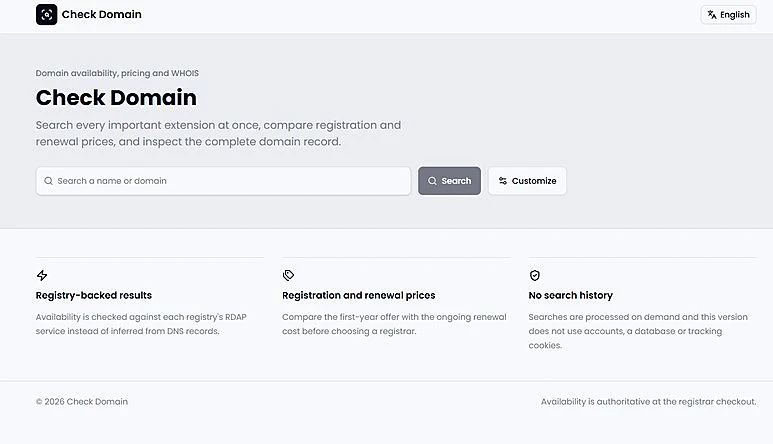
Round Two — Using a Domain Name Generator
Participant: The same individual. Tools: A popular, modern domain name generator. Process: Inputted the same three seed keywords ("Expense," "Remote," "Track") and utilized the tool’s built-in features like "smart merge" and prefix/suffix additions.
The First 60 Seconds: Volume Advantage
The contrast was immediate. Within 60 seconds of clicking "Generate," the screen was populated with over 50 suggestions.
The cognitive load shifted instantly. Instead of trying to create ideas from a blank slate, the participant’s role shifted to curating ideas from an abundant list.
Filtering Becomes the New Bottleneck
While the generator solved the problem of "having no ideas," it created a new, different challenge: "too many ideas."
The first few pages of results included substantial "noise"—bizarre, nonsensical combinations. However, because the volume was so high, the likelihood of stumbling upon a gem increased exponentially.
The participant spent the remaining time scanning the list, quickly flagging interesting options, and opening new tabs to Check Domain availability in real-time.
Final Count and Quality Check
In 15 minutes, the tool generated 47 distinct suggestions worth considering.
After performing a quick trademark sanity check and filtering for immediate .com availability, the results were starkly different from Round One:
- Immediate .com availability: 14 usable, non-hyphenated .com domains were identified.
- Usability Score (1-5 scale): Average score of 3.5. Several options felt genuinely modern and scalable (e.g., RemotelySpent.com).
Head-to-Head Comparison
When we stack the data side-by-side, the results quantify exactly where each method excels.
Regarding Time to First Available .com: Manual brainstorming took 11 minutes to reach one usable name. The generator delivered its first three available options in under 90 seconds.
Regarding Total Usable Candidates in 15 Minutes: The manual session produced 1. The generator session produced 14.
Regarding Decision Fatigue: The manual method resulted in high fatigue due to the "creativity wall." The generator method resulted in medium fatigue, but it was a different type—the fatigue of curation and selection rather than creation.
What the Data Actually Reveals
The results challenge the assumption that one method is universally better.
Generators Win on Speed and Volume, Not Nuance
If your primary goal is to secure a domain today so you can set up email and start building, a domain name generator is the only logical choice. It bypasses creative block and provides immediate validation.
However, the "quality" issue remains. The names produced by algorithms are often derivative. They rely heavily on common startup naming conventions (adding "-ly", "-ify", or mashing two words together). They frequently lack the cultural nuance or clever double meanings a human brain can produce.
Manual Brainstorming Wins When Nuance Is Required
If the brand identity relies on a subtle pun, deep cultural resonance, or a very specific emotional connection, the machine fails.
In our test, the human brain naturally veered toward concepts around expense tracking (like trust, visibility, freedom) rather than just the mechanics of it. While the generator produced "functional" names, the human was capable of producing "evocative" names—it just took too long to find the available ones.
The Hybrid Approach Outperforms Both
The most important takeaway isn't which method is better, but how they can complement each other to save maximum time.
The most efficient workflow is neither "manual brainstorming" nor "using a generator." It is a Hybrid Workflow.
We replicated the test using this hybrid sequence, and it yielded the best results in the shortest time:
- Manual Phase (First 5 Minutes): Define the vibe and brainstorm 3-5 seed keywords. Don't check availability yet. Just explore themes and emotions.
- Generator Phase (Next 5 Minutes): Feed those thematic keywords into a domain name generator. Immediately use the bulk Check Domain feature to filter out the noise and see what is actually on the table.
- Selection Phase (Final 5 Minutes): Review the shortlist of available names the tool provided and make the final decision.
Using this hybrid approach, we found a top-tier, brandable name in under 8 minutes.
When Each Method Makes Sense
To maximize your time, choose your strategy based on your current constraints.
Use Manual Brainstorming When:
- You have ample time (days or weeks) to develop a deep brand identity.
- The name requires cultural context, complex puns, or deep emotional resonance.
- You are naming a premium, high-stakes brand where algorithm-generated names feel too "cheap" or generic.
Use a Domain Name Generator When:
- You are launching an MVP, a side project, or a rapid test landing page.
- You need to check domain availability across multiple TLDs (.io, .co, .ai) instantly.
- You are stuck in a creative rut and need "brainstorming fuel" to get unstuck quickly.
Final Thought
The real debate isn't about how long it takes to generate a list of names. It’s about how long it takes to find the right name that you won't regret in six months.
Manual brainstorming risks wasting time because you fall in love with names you can't have. Relying solely on a generator risks wasting time because you settle for a generic name just because it was available.
True efficiency comes from using human creativity to set the direction and machine intelligence to handle the validation. When you check domain availability using automated tools after a short human-led thematic brainstorm, you strike the perfect balance between speed and quality.