Customers today don’t just want answers—they want answers instantly, and they want to feel heard in the process. The world of customer service has shifted dramatically, and businesses can no longer hide behind long hold times or generic FAQ pages.
AI has stepped in to transform how brands handle customer conversations, but the reality is clear: machines alone aren’t enough. People still crave empathy, creativity, and reassurance when things go wrong.
That’s where the future lies—in hybrid support models that combine the speed and intelligence of AI with the warmth and intuition of human agents.
For businesses that want to scale, reduce costs, and still deliver world-class service, this balance isn’t optional. It’s the standard customers are coming to expect.
If you’re wondering how this hybrid model works, why it matters, and what it means for the future of your business, keep reading. This article breaks it down from the ground up.
The Evolution of Customer Support
Not too long ago, customer service meant calling a hotline, waiting on hold, and hoping an agent could solve your problem. For businesses, this model was expensive, and for customers, it was painfully slow.
Then came the first wave of automation: interactive voice response (IVR) menus, basic email ticketing systems, and early chatbots. These tools promised efficiency but often delivered frustration—rigid scripts, robotic voices, and endless "please press 1" loops.
Dan Rogers, Creative Director at Rebus Puzzles, explains, "Early automated systems felt mechanical because they focused more on process than understanding. As technology evolves, the real improvement comes from designing systems that respond to people the way a thoughtful conversation would—clear, intuitive, and easy to follow."
Fast forward to today, and AI has evolved past those clunky beginnings. Modern systems use natural language processing, sentiment analysis, and machine learning to understand context. Instead of forcing customers to adapt to the machine, AI now adapts to the customer.
This evolution marks a major turning point: support is no longer about managing queues—it’s about creating conversations that feel natural, fast, and personal.
What AI Brings to the Table
AI is the powerhouse of modern customer service. First and foremost, it brings speed. Customers can get answers 24/7, whether they’re shopping online at midnight or troubleshooting a product on a Sunday afternoon.
Tariq Attia, Founder of IW Capital *— *EIS Investment, says, "Technology tends to create the most value when it improves efficiency at scale. In many industries, automation allows organizations to serve far more people without proportionally increasing operational costs."
This scalability means businesses can handle thousands of inquiries at once, something no human-only team could pull off without massive costs.
But speed isn’t the only factor. AI thrives on personalization. By tapping into customer data, AI systems can recall past purchases, track browsing behavior, and even predict what a customer might need before they ask.
Add sentiment analysis to the mix, and you have bots that can adjust their tone when a customer is frustrated versus when they’re casually browsing.
In an interview, Edward Tian, CEO of GPTZero, said, "Advances in machine learning have made it possible for systems to interpret language and context much more accurately. The goal is not just automation, but creating interactions that feel responsive and genuinely helpful."
Industries are adopting these tools at record pace. In e-commerce, AI instantly recommends solutions or products. In banking, it flags suspicious activity and guides customers through secure steps.
In healthcare, it helps triage patient questions before connecting them to professionals. In all cases, AI reduces wait times and increases accuracy while driving down operational costs.
Australian insurer NIB reported that by shifting a large share of customer interactions to AI-powered digital assistants, it cut service costs by nearly 60%. The move translated into more than $22 million in savings, proving how powerful AI can be when it comes to reducing operational overhead while still keeping service accessible and responsive.
.jpg?x-image-process=image%2Fauto-orient%2C1%2Fresize%2Cm_lfit%2Cw_1920%2Fsharpen%2C100%2Fformat%2Cwebp%2Fmarker%2Cu_plus)
Image source: Desk365
The Human Advantage That Machines Can’t Replace
For all its strengths, AI still lacks something fundamental: empathy. A bot might know your purchase history and detect you’re upset, but it can’t genuinely care about your problem.
Human agents bring an emotional layer that machines can’t replicate. When a customer is angry, anxious, or facing a complex issue, having a calm, empathetic voice on the other end makes all the difference.
Humans also excel in situations where creativity is required. AI follows patterns—it can analyze thousands of similar cases—but when a unique, out-of-the-box solution is needed, human intuition leads.
This is especially critical in high-stakes industries like healthcare, legal services, or financial planning, where trust is built through reassurance and nuanced communication.
And let’s not forget loyalty. Customers rarely rave about the time a chatbot solved their problem, but they do remember when a human agent went above and beyond. Those moments of empathy and personal connection turn frustrated customers into brand advocates. AI can set the stage, but it’s the human touch that seals the deal.
The Hybrid Model: Best of Both Worlds
Instead of viewing AI as a replacement for humans, the smartest companies are designing hybrid models where the two work together. In this setup, AI handles the repetitive, high-volume tasks—like answering FAQs, resetting passwords, or checking order statuses. When the problem escalates, the handoff to a human agent is seamless, ensuring customers never feel abandoned in a loop.
LJ Tabango, Founder & CEO of Leak Experts USA, adds, "Service businesses deal with urgent customer questions all the time. Technology can quickly handle routine updates or basic information, but complex issues still need someone who can listen, understand the situation, and guide the customer toward the right solution."
More than half of today’s consumers say that when they need quick answers—like tracking an order or resetting a password—they actually prefer engaging with a bot instead of waiting for a human agent. This shift highlights how customer expectations are no longer just about empathy but about immediacy.
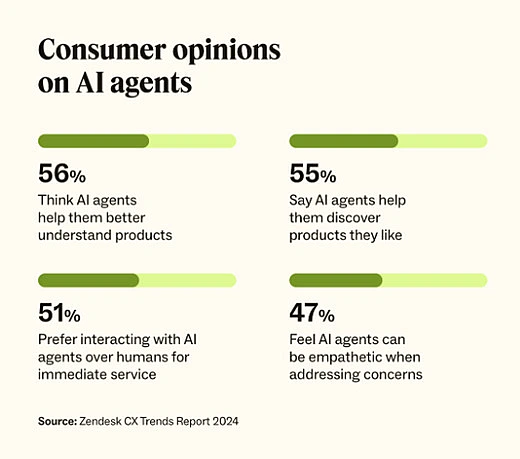
Source: Zendesk
For simple, high-volume requests, speed wins every time. It doesn’t mean people want to replace human agents altogether, but it shows why AI has become such an essential part of modern customer support. Customers are signaling that convenience and efficiency are just as valuable as the human touch, especially when the issue is straightforward
But the hybrid model isn’t just about dividing tasks—it’s about collaboration. AI can assist human agents in real time, pulling up relevant knowledge articles, summarizing a customer’s history, or even suggesting next steps. This makes the human’s job faster and easier, freeing them up to focus on the emotional side of the interaction.
Rachel Sinclair, Acquisitions Director at US Gold and Coin, says, "Digital tools can answer routine questions quickly, but important financial decisions still benefit from human conversation. When technology handles the basic inquiries, advisors can spend more time helping customers understand complex choices."
Real-world examples show the impact. In e-commerce, hybrid models reduce cart abandonment by instantly answering product questions before customers give up. In healthcare, AI triages common inquiries so nurses can focus on urgent cases. In banking, AI handles account checks while humans step in for fraud disputes or loan discussions.
The result? A customer experience that feels efficient, personalized, and human—without overwhelming business resources.
Challenges in Building Hybrid Support Systems
While the benefits are clear, building a true AI-human hybrid system is not as simple as plugging in a chatbot and hiring agents. One major challenge is integration. Many businesses still run on outdated customer relationship management (CRM) systems or siloed data, making it difficult for AI tools to access the full picture of a customer’s history. Without this visibility, personalization falls flat.
Digital platforms only work well when the underlying systems talk to each other. In property marketplaces, fragmented data often prevents platforms from giving users a clear experience. The same principle applies to customer support—without connected systems, even the most advanced AI struggles to deliver meaningful help.
There’s also the issue of trust. Customers want to know when they’re talking to a bot and when they’re talking to a human. Brands that blur this line risk alienating their audience. Transparency is essential—AI should never pretend to be human, but rather position itself as a fast first step that connects you to the right solution.
Employee resistance can’t be ignored either. Some agents fear that AI is coming to replace them, when in reality, it should make their jobs easier. Companies need to invest in training, not just on how to use the technology but also on how to elevate their uniquely human skills—empathy, problem-solving, and creativity—so they complement the machines instead of competing with them.
Also, there’s cost. While AI tools are becoming more accessible, implementing them at scale with seamless handoff, multilingual support, and continuous updates is not cheap. Businesses must balance short-term expenses with the long-term gains in efficiency and loyalty.
Rameez Ghayas Usmani, Award-Winning HARO Link Builder & CEO of HARO Link Building, adds, "Technology can automate many processes, but trust still depends on human judgment and clear communication. Even in digital outreach and media relations, the most effective systems combine automation with thoughtful human oversight."
Data Privacy and Ethical Considerations
With AI handling so many customer interactions, questions of privacy and ethics naturally arise. Every interaction generates data—from account details to behavioral signals—and customers are increasingly sensitive about how that information is collected and used. A single data breach can undo years of trust in seconds.
Ákos Doleschall, Managing Director at Hustler Marketing — Ecommerce Email Marketing Experts, mentions, ""Trust becomes fragile when data is involved. In digital marketing, even a small misuse of customer information can damage relationships that took years to build. Strong privacy practices are no longer optional—they’re part of the customer experience itself."
This makes data security non-negotiable. Companies adopting AI must ensure they’re compliant with regulations like GDPR or CCPA, encrypting sensitive data and offering customers transparency about what’s being stored.
Beyond compliance, businesses also need to consider bias in AI systems. A poorly trained bot may inadvertently provide unfair responses, leading to reputational risks and legal concerns.
According to Bill Sanders, from TruePeopleSearch, "Information systems today process enormous volumes of personal data, so accuracy and responsible handling become critical. When companies manage data carefully and communicate clearly about how it’s used, people feel more confident interacting with digital services."
Ethical AI isn’t just about avoiding mistakes—it’s about building systems that reflect your brand’s values. If your company prides itself on customer care, then your AI must be designed to support, not frustrate, customers. This requires continuous monitoring, retraining, and human oversight to ensure that AI doesn’t just work—it works responsibly.
Future Trends in AI-Human Support Models
The hybrid model we see today is just the beginning. Future support systems will blur the lines even further, using advanced AI that doesn’t just respond but anticipates needs. Imagine a system that recognizes when someone has searched the same FAQ several times and offers a callback from a human agent before frustration builds.
Karen Noryko, Career Content Director at Jobtrees, said, "Technology is increasingly designed to understand patterns in user behavior. When systems recognize repeated questions or actions, they can step in earlier with the right support, creating a smoother experience for the person looking for help."
Voice AI will also become more sophisticated, moving beyond robotic tones toward conversations that sound natural and responsive. Multilingual capabilities will expand as well, allowing businesses to assist customers in different languages through real-time translation.
On the backend, AI copilots for agents will become far more common. These systems will provide real-time suggestions, highlight potential compliance concerns, and help agents respond more effectively during conversations.
Support systems are gradually shifting from simple automation toward intelligent assistance. AI tools can already analyze conversations, highlight important signals, and guide human agents toward faster and more accurate responses.
We’ll also see deeper integration with other customer-facing technologies. AI support won’t live in isolation—it will connect with marketing, sales, and product feedback loops, ensuring that customer conversations directly shape business strategy.
This evolution will make hybrid support less about solving problems reactively and more about driving growth proactively.
Conclusion
The future of customer conversations doesn’t belong to AI alone, nor to humans—it belongs to the hybrid models that blend the two. Customers want the best of both worlds: the speed and precision of machines with the empathy and creativity of people.
Businesses that can deliver this balance will not only solve problems faster but also build stronger, more meaningful relationships with their customers.
For entrepreneurs, startups, and established enterprises alike, the takeaway is simple: hybrid support isn’t just a trend. It’s the foundation of customer experience in the years ahead. Those who embrace it will find themselves not just keeping pace with customer expectations, but leading the way in building trust, loyalty, and long-term success.