Last month, I finally packed my $4,000 cinema camera into its hard case and slid it under my desk. It has been sitting there ever since, gathering dust alongside my three-point lighting rig and my collection of expensive camera lenses.
If you had told me three years ago that I would abandon my physical recording gear to produce high-performing brand content for YouTube and TikTok, I would have laughed. I was a purist. I believed that true visual storytelling required a heavy camera, hours of manual color-grading, and a massive editing timeline.
But things changed. The social media landscape evolved, the algorithms demanded relentless volume, and a new generation of creative tools completely broke the traditional production pipeline. This is not a story about getting lazy; it is about how we went from being manual camera operators to actual creative directors, using VideoAI to run entire digital campaigns from a single dashboard.
The Golden Era of Gear: When High Production Value Ruled the Feed
Go back to 2018. If a direct-to-consumer brand wanted to launch a new product on social media, the playbook was incredibly rigid. You hired a production crew, scouted a physical location, set up softboxes, and spent an entire day shooting three 15-second ads.
We used to think that the more expensive the lens, the higher our click-through rate would be. We spent thousands of dollars making sure our backgrounds had the perfect, blurry bokeh and our audio was flawlessly crisp. A single campaign took three weeks of post-production, including endless back-and-forth emails about color correction and audio levels.
This workflow was satisfying for gearheads, but it was a massive bottleneck for brands. We were spending a significant portion of our marketing budget on the physics of video production—renting lights, organizing permits, and fixing focus issues—rather than focusing on the actual hook, angle, or story.
The Mid-Tier Burnout: Why Spending $5,000 per Social Video Died
By 2024, that high-budget, slow-motion approach hit a wall. Social platforms shifted to a high-volume feed model where content lifespans were measured in hours, not weeks. If you spent $5,000 on a single gorgeous video, it was pushed down the user's feed by lunchtime, replaced by a casual, organic clip shot on a phone.
I remember working with a minimalist backpack startup that spent their entire quarterly creative budget on a beautiful cinematic shoot in a rainy forest. The video looked like a high-end car commercial, but within forty-eight hours of posting, the algorithm stopped pushing it. They desperately needed twenty more variations to test different hooks, target different demographics, and adjust to comments, but the budget was entirely gone.
We could not keep up with the volume. To survive in this environment, creative teams had to find a way to scale their visual output without losing their brand's aesthetic. The data supported this shift; according to PwC's 2026 AI Jobs Barometer, workforce productivity growth is 40% higher at companies most exposed to AI compared to those least exposed.
For our creative team, this meant automating the rendering process so we could focus entirely on the concepts. This realization led us to integrate our first dedicated AI Video Generator into our daily workflow, transforming our production timelines from weeks into minutes.
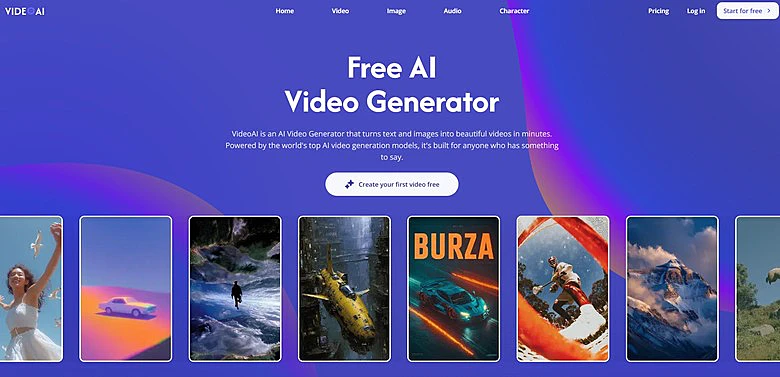
The Rise of the Algorithmic Studio: How VideoAI Redefined Our Daily Pipeline
Instead of setting up physical cameras, we now build our brand content using VideoAI. The software acts as a multi-model workspace, housing premium engines like Kling, Seedance, and Veo under a single interface. This allows us to select the best engine for each specific visual task.
codeCode
[Static Product Image] ➔ [Image to Video AI] ➔ [Select Kling for Realism] ➔ [3-Second Visual Spot]
⬇
[Add Multi-Voice Lip Sync]
⬇
[Finished Social Ad]
When we need to test a quick, concept-driven hook, we use Text to Video AI. If we want to show a character walking through a neon-lit city carrying our brand's backpack, we no longer need to buy plane tickets or coordinate a night shoot. We type our prompt, choose our preferred rendering style, and generate high-fidelity footage in seconds.
For product-focused assets, we rely heavily on Image to Video AI. We upload a crisp, high-resolution product shot of our backpack, select the "Frame to Video" module, and instruct the engine to animate the water droplets sliding off the weather-resistant fabric.
The main difference between this modern workflow and earlier AI attempts is the lack of a single-model bottleneck. In older tools, if the native model struggled with human movement, every single output looked plastic and unnatural. With VideoAI, we can route our high-action scenes to Kling for physical realism, and use Luma or Seedance for stylized background transitions.
From Camera Operator to Creative Director: What Our Job Looks Like Now
The transition to algorithmic production does not mean human creativity is obsolete. If anything, our role has become more elevated and strategic. We have shifted from being technical executors—people who worry about exposure meters and lens dust—to creative directors who focus on narrative, pacing, and emotional connection.
A modern AI Video Generator can render a highly complex scene in under a minute, but it cannot understand human irony, brand humor, or cultural nuance. It still requires a human director to write the script, select the visual tone, review the output for subtle errors, and structure the final edit.
Our value is no longer in our ability to hold a heavy camera steady; it is in our judgment and taste. We spend our mornings brainstorming high-converting hooks and analyzing performance metrics, and our afternoons directing multiple AI models to compile our assets. The physical production bottleneck has vanished, leaving us with a faster, more agile, and highly scalable creative pipeline that keeps our brand's social feeds constantly supplied with fresh, engaging content.