The landscape of academic research is undergoing a seismic shift, moving from manual drudgery to intelligent automation. We are no longer just "writing" papers; we are managing complex data ecosystems.
For modern researchers, the enemy isn't the lack of information—it's the overwhelming abundance of it. This is where Artificial Intelligence steps in, not just as a creator of text, but as a processor of logic.
In this deep dive, we explore how tools like Koke AI are leveraging intelligent data to transform the scholarly process. We will look at how algorithms assist in everything from structuring arguments to the precise demands when you need to generate Chicago citation formats.
The friction in modern scholarship
The data deluge
According to recent academic reports, the global output of scientific papers grows by approximately 4% annually. For a PhD student or a serious researcher, keeping up with this torrent of data is humanly impossible.
Reading, synthesizing, and organizing hundreds of PDFs creates a cognitive bottleneck. The traditional method of highlighting physical papers and typing out bibliographies is archaic.
The citation nightmare
Then comes the technical precision required for attribution.
Different disciplines demand different languages of citation. History and humanities students, for instance, often face the notorious complexity of the Chicago Manual of Style.
The struggle to manually handle footnotes and bibliographies often breaks the flow of writing. This friction is where data-driven AI tools have found their most vital market entry.
Enter Koke AI: A case study in intelligence
More than just a Chatbot
Koke AI represents the second generation of academic AI tools. Unlike generic LLMs (Large Language Models) that merely predict the next word, Koke AI is designed with a specific academic logic layer.
It functions as a suite of specialized tools rather than a single chat interface. The platform integrates an Outline Generator, a PDF Summarizer, and a precision-focused citation engine.
The architecture of "Smart Data"
What makes Koke AI interesting from a technical standpoint is how it handles structured data.
When you upload a paper, the system doesn't just "read" the text; it parses the metadata—DOIs, author credentials, and publication dates. This structured approach is what allows for high-fidelity summarization and accurate referencing.
The engine room: How smart data powers research
Semantic analysis and knowledge graphs
At the heart of Koke AI’s effectiveness is its ability to perform semantic analysis. It understands that a "result" in a chemistry paper carries different weight than a "result" in a sociology paper.
By mapping these relationships, the AI can suggest logical outlines that fit academic standards. It uses a form of localized knowledge graphing to ensure that when it summarizes a PDF, it captures the hypothesis and conclusion, not just random sentences.
Automating the metadata retrieval
The most tangible benefit of this data processing is seen in citation generation.
When you input a URL or DOI, the system queries reliable databases (like Crossref or PubMed) to retrieve verified metadata. This ensures that the information isn't "hallucinated" by the AI, but fetched from authoritative sources.
Hands-On Test: From chaos to clarity
The outline generator experience
I tested Koke AI with a vague topic: "The Impact of AI on 19th Century Industrial Historiography."
The Outline Generator didn't just give me generic headings. It provided a logical flow: Introduction, Literature Review, Methodology, and Case Studies. It acted as a structural architect, breaking my writer's block instantly.
Navigating the summarization tool
I fed the system a dense, 20-page academic PDF on economic theory.
Within seconds, Koke AI distilled the core arguments into bullet points. The "Key Concepts" extraction feature saved me at least an hour of reading time, allowing me to decide immediately if the paper was relevant to my work.
The "Chicago" challenge
Here is where the precision matters most.
As a test, I needed to generate Chicago citation styles for a bibliography. I inputted the DOI of a specific history journal article.
Mastering the Chicago Citation Generator
Why Chicago Style is tricky
Chicago style (Notes and Bibliography system) is notoriously unforgiving. It requires specific punctuation, italicization, and formatting that differs between footnotes and the final bibliography.
Most generic citation tools fail here, often confusing authors' first and last names or misplacing the publication year.
The Koke AI solution
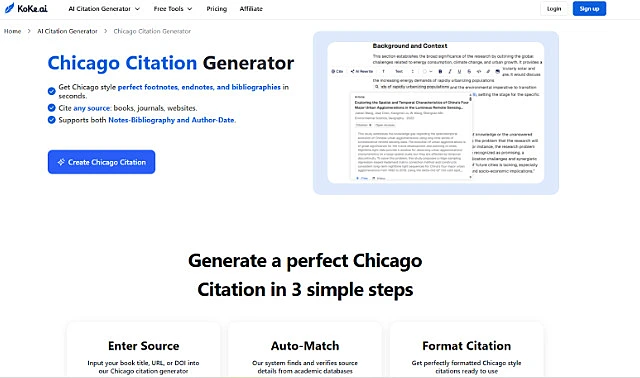
I navigated to the Chicago Citation Generator within the platform. The interface was clean and distraction-free.
I pasted the DOI. The AI fetched the data: Author, Article Title, Journal Name, Volume, Issue, Date, and Page Range.
The result was a perfectly formatted entry. It handled the nuances—like italicizing the journal title but putting the article title in quotation marks—flawlessly.
Building the library
Beyond a single citation, the tool allowed me to save this entry to a "Project Library."
This means I could generate citations for 20 distinct sources and export them all at once. For a thesis student, this feature transforms a week of formatting work into a ten-minute task.
The reality check: Strengths and limitations
The pros
- Speed: The time saved on PDF summarization is a game-changer for literature reviews.
- Accuracy: The Chicago Citation Generator proved highly reliable during my testing, pulling correct metadata even for obscure sources.
- Integration: Moving from outlining to researching to citing in one tab keeps the workflow fluid.
The cons
- Dependency Risks: Over-reliance on the outline generator might stifle original structural creativity if users aren't careful.
- Data Gaps: While excellent for digital sources, older, non-digitized books still require manual input (though the tool handles the formatting once you type the details).
Who is the ideal user?
The academic researcher
For PhD candidates and professors, the PDF summarization and library management features are invaluable. They allow for the rapid processing of large volumes of literature.
The humanities student
History, Arts, and Philosophy students specifically benefit from the specialized Chicago Citation Generator. These fields rely heavily on this complex style, and automating it removes a significant barrier to entry.
The ESL writer
For researchers whose first language isn't English, the AI helps structure thoughts logically. It ensures that the "academic tone" is maintained throughout the outline and citation process.
Reshaping the market: Why this matters
The trend of "Co-Pilot" research
We are seeing a move away from "AI writing the paper for you" (which is ethically gray) to "AI managing the data for you."
Tools like Koke AI position themselves as research assistants, not ghostwriters. This distinction is crucial for academic integrity.
Data as the New Ink
The future of academic writing is data-integrated.
Universities and institutions are beginning to recognize that using AI for formatting and summarization is a valid efficiency skill. The ability to manage a bibliography using a Chicago Citation Generator is becoming as standard as using a spell-checker.