Ask ten HR leaders to name the most popular HR & HRIS systems in the UK and you'll get ten different answers, most of them shaped by whichever tool the last person happened to use. Popularity deserves a firmer test than gut feel. G2 review counts for the HR platforms used by UK businesses range from a few dozen to well over ten thousand. Those figures tell only part of the story. When combined with average ratings and how often each platform appears on buyer shortlists, they paint a clearer picture of which systems UK companies are actually choosing in 2026. That gives this ranking a stronger foundation than opinion alone.
This roundup ranks five top platforms that consistently surface on UK shortlists, using real G2 ratings and review volumes as the evidence for "popular" instead of vendor claims. Each entry covers what the system does well, an honest limitation drawn from user reviews or product scope, and where its pricing starts, so you can weigh reputation against fit. First, a short note on how the ranking was built, then the comparison table, then a detailed look at every option.
How the most popular HR & HRIS systems in the UK compare
UK HR teams rarely have the headroom to trial a dozen systems, so a like-for-like view of rating, review depth, and entry price does a lot of the early filtering. The table below summarises where each platform fits, what it costs to start, and how users score it, followed by a full breakdown of every entry.
How we measured popularity in this ranking
"Popular" only means something if you can point at the numbers behind it, so this list leans on three signals rather than reputation alone.
The first is a UK-specific review volume. A high star average from forty reviews says less than a slightly lower average from four thousand, because the larger sample reflects more real deployments and a wider spread of team sizes. Where a UK-specific G2 figure exists, such as HiBob's UK page citing around 2,332 reviews or Rippling's roughly 12,711, this ranking uses it. Some counts, like BambooHR's 5,600-plus, are G2 totals that include buyers outside the UK, and those are treated as directional rather than exact.
The second is average rating, taken from G2 and hedged where a vendor has thin coverage. Sage HR's 4.3/5 sits on fewer than a hundred reviews, for instance, so it carries less weight than the same score backed by thousands.
The third is shortlist presence, meaning how often a platform appears on UK buyer guides, comparison pages, and G2 Editor's Pick or leader placements. A system that shows up again and again in front of British buyers is, by any working definition, popular.
Ordering blends those three with fit for a typical UK mid-market team, which is why HiBob leads: it pairs a strong UK review standing with native UK payroll and regular shortlist appearances. Higher raw ratings exist further down the list, and the entries say so plainly. Ratings and prices shift by source and over time, so treat every figure here as a 2026 snapshot to verify in a live demo.
1. HiBob
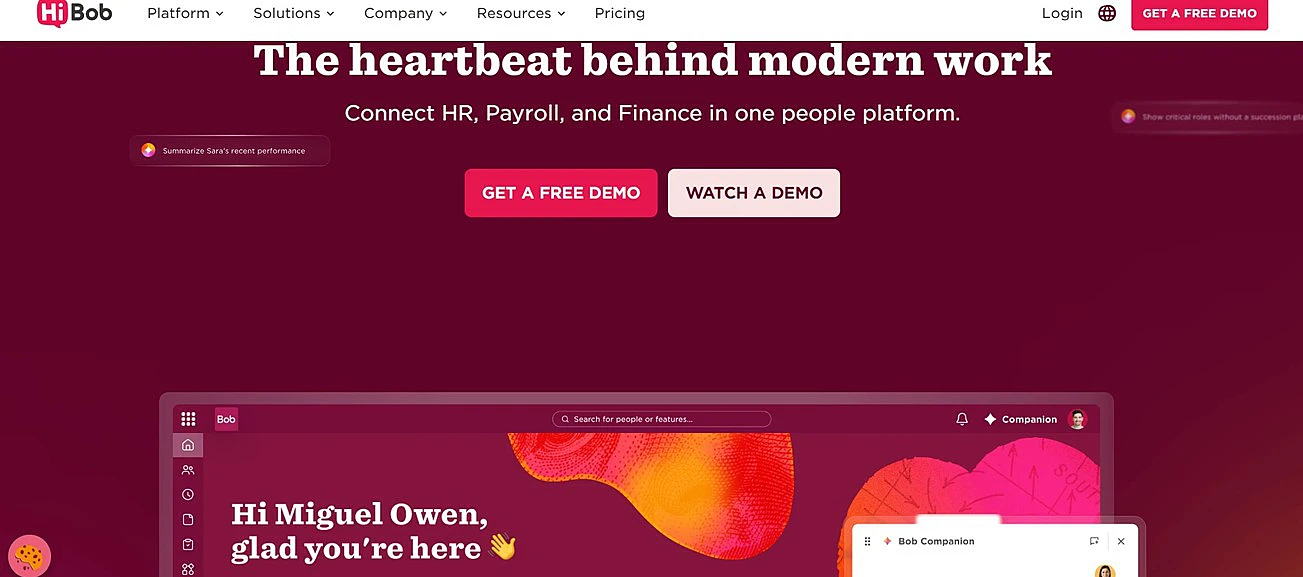
At a glance: 4.5/5 on G2 · roughly 2,332 UK reviews · best for modern mid-market teams that want people, pay, and hiring on one connected system.
Bob sits at the top of this list because it settles the question a scaling UK company keeps running into: whether a single platform can hold people records, payroll, hiring, and reporting without a chain of tools patched together by hand. The evidence sits behind the reputation, with a G2 average around 4.5/5, roughly 2,332 reviews on its UK page, a 4.6/5 mark on Capterra, and a habit of turning up on British buyer shortlists. Native UK payroll runs inside the platform, so HMRC-recognised RTI submissions, PAYE and NI, and pension auto-enrolment share a record with everything else rather than syncing across systems.
The mobile-first design pulls daily use from the whole workforce, which is what earned Bob the "Instagram of HCM" tag from analyst Josh Bersin, and AI plus Mercer-powered compensation benchmarking give pay decisions an external reference without a separate data subscription. Cost sits behind a sales conversation, scoped around a core platform plus the suites you switch on, and most organisations go live in weeks.
Standouts:
- Native UK payroll handles RTI and pension auto-enrolment in-platform, keeping pay and people data on one record.
- Core HR, hiring, headcount planning, compensation, and analytics live in a single system, which strips out the CSV exports fragmented stacks depend on.
The trade-off is that Bob keeps its pricing off the page, so you model cost through sales rather than list rates, native payroll currently reaches the UK and US only with other countries routed through Payroll Hub, and some UK reviewers find support slow to answer.
2. Personio
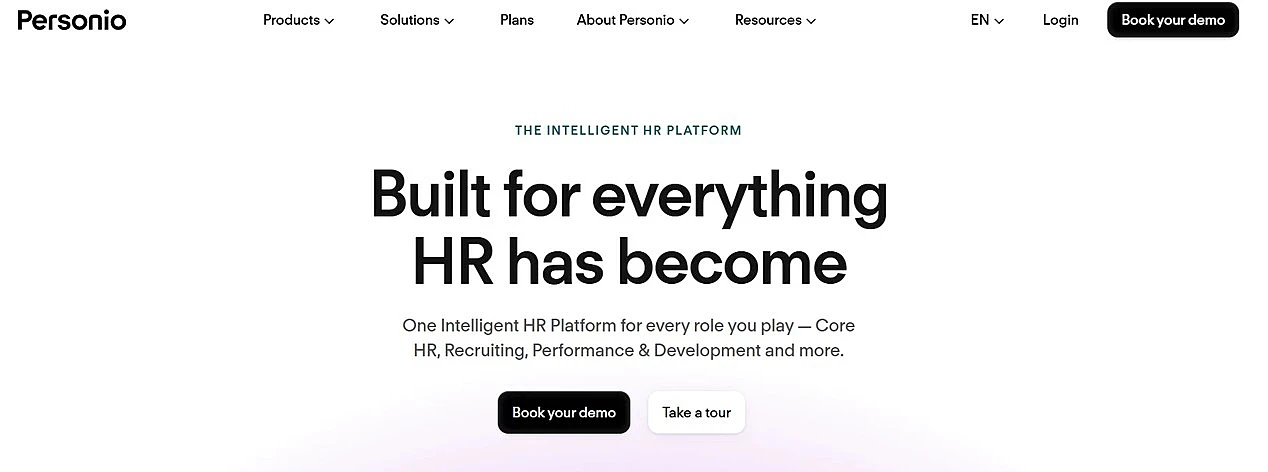
At a glance: 4.4/5 on G2 · roughly 840 reviews · best for European SMB and lower mid-market teams centralising core HR.
Personio grew up in Europe and, since stepping back from the US market, leans harder into that regional focus, which suits UK and continental teams after core HR without enterprise bulk. Reviewers describe a system that's quick to learn and quicker to pull scattered employee data into a single hub, replacing the spreadsheet sprawl that lean teams accumulate.
Approval flows and recurring HR tasks run on rules rather than manual chasing, and built-in Slack and Outlook connections surface requests where staff already spend their day. The product is shaped around European and UK working practices rather than retro-fitted from a US core. Third-party estimates put entry pricing near £4 to £5 per employee per month on custom, headcount-scoped quotes, so confirm the figure on a proposal.
Standouts:
- Employee records, absence, and documents consolidate into one hub reviewers credit with tidying years of scattered files.
- Rules-based automation with everyday Slack and Outlook integrations keeps routine HR close to where people work.
The limits show in reviews that call the mobile app restricted, note customisation still wants work, and read the US withdrawal as a narrower geographic reach than global-first rivals.
3. Sage HR
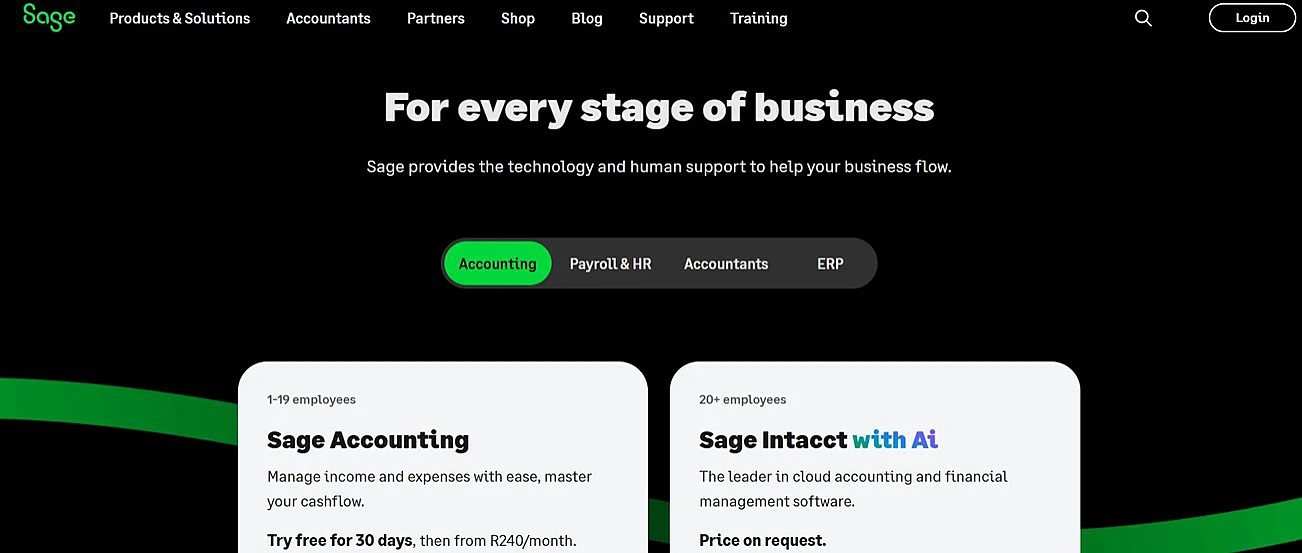
At a glance: 4.3/5 on G2 · roughly 90 reviews · best for teams already standardised on Sage finance software.
Sage is a fixture in UK finance software, and Sage HR carries that familiarity into people management through a modular design that slots into the wider Sage ecosystem. Core HR, leave, timesheets, and performance arrive as modules you switch on as needs grow, while employees handle their own leave requests and detail updates to ease routine load. Standard reports and org charts cover day-to-day visibility for smaller teams, and the shared vendor makes it an easy shortlist entry for a company already running Sage accounts. Pricing starts around £5 to £7 per employee per month depending on the modules chosen, with payroll billed separately, though the score rests on a modest base of roughly 90 reviews, so read it as directional.
Standouts:
- Modular structure and native Sage-ecosystem fit reward finance teams already invested in the vendor.
- Self-service basics and straightforward reporting make it quick for small teams to adopt.
The catch is payroll, which isn't native, so RTI and auto-enrolment run through separate Sage Payroll, and reviewers find the interface basic once tasks get complex.
4. BambooHR
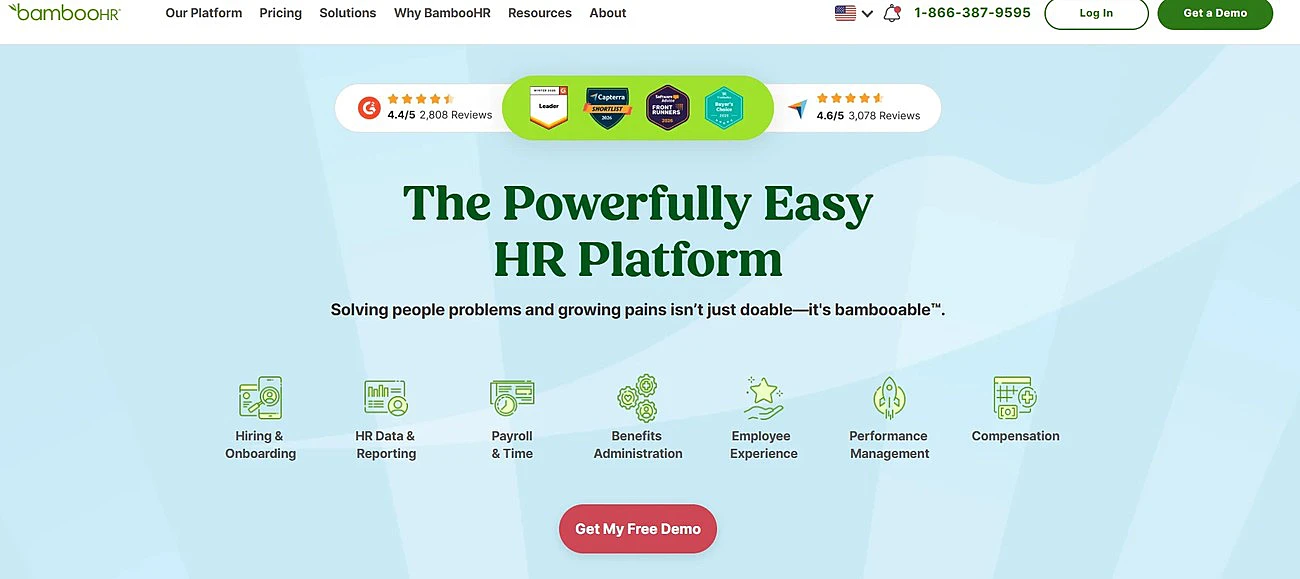
At a glance: 4.4/5 on G2 · 5,600+ reviews · best for SMB teams wanting approachable all-in-one core HR.
BambooHR has built a large, loyal following, reflected in a G2 base north of 5,600 reviews, on the back of an interface staff pick up with next to no training. Employee records, time-off tracking, and a company calendar sit in one hub reviewers consistently call easy, and its self-service app takes routine questions off a small HR function. Onboarding workflows get digital paperwork signed before a new hire's first day, a built-in ATS handles job postings and candidate records with automated applicant emails, and an open API with broad integrations connects payroll, benefits, and other systems. Tiered pricing starts near $10 per employee per month in US dollars, with a roughly $250 monthly floor for teams under 25, higher Pro and Elite tiers, and payroll and benefits billed as add-ons that push the real bill past the headline.
Standouts:
- Fast staff adoption cuts training time and lowers the volume of self-service questions reaching HR.
- Broad brand recognition and a deep review base make it a well-understood, low-surprise choice.
Reviewers flag thin performance-review and goal-setting tools plus weak analytics that push users to export data themselves, and the platform can feel limiting as headcount climbs.
5. Rippling
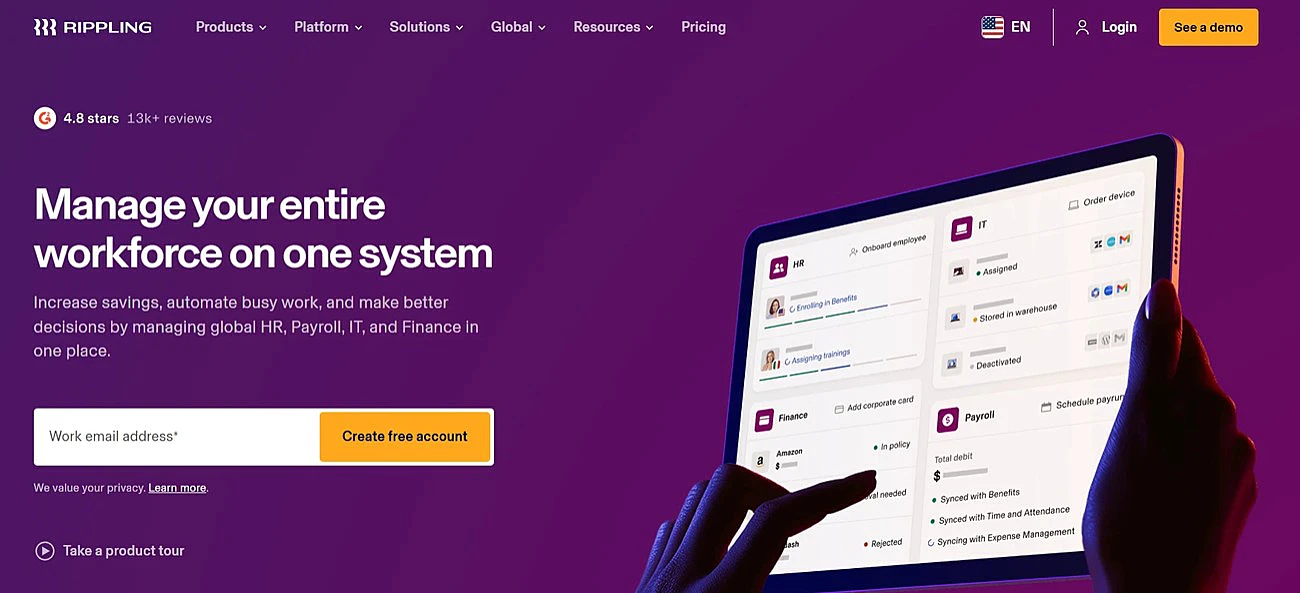
At a glance: 4.8/5 on G2 · roughly 12,711 UK reviews · best for teams joining HR, IT, and payroll into one automation engine.
Rippling posts the deepest review base and one of the highest ratings in this comparison, roughly 12,711 UK reviews at around 4.8/5, thanks to a system that folds HR, IT, and payroll into a single automation engine. Bringing on a hire can fire off payroll setup, app access, and a configured laptop from one workflow, and a rules engine triggers downstream actions on its own, which users single out as the standout capability. Native UK payroll now runs HMRC-recognised RTI, auto-enrolment, minimum-wage alerts, and P45 and P60 handling in-platform, while prebuilt connectors and an open API link it to a wide app ecosystem. Pricing starts around £7 to £8 per employee per month, though the final figure tracks which modules you enable and isn't fully transparent upfront. Its Capterra average sits near 4.9/5.
Standouts:
- Cross-department automation removes hours of manual onboarding across HR, payroll, and IT.
- Native UK payroll sits behind one of the largest, highest-rated review bases in this list.
Reviewers describe a cluttered, disjointed interface with a steep admin learning curve, and some report sales over-promising against what higher tiers deliver, so scope the quote with care.
Which of the most popular HR & HRIS systems in the UK fits your team
The most popular HR & HRIS systems in the UK earn their standing in different ways, and the right pick comes down to where your friction actually lives. Rippling posts the highest ratings and, in Rippling's case, the deepest review base, rewarding teams that want HR-IT automation or cross-border hiring. BambooHR brings scale and recognition for SMB core HR and enterprise payroll respectively. Personio and Sage HR each solve a narrower slice, from European core HR to spreadsheet-replacement leave tracking.
Bob takes the top spot for the problem most UK mid-market teams are really trying to solve: running people records, native UK payroll, hiring, and analytics on one connected system that staff genuinely use, backed by a strong UK review standing near 4.5/5 across roughly 2,332 reviews and regular shortlist appearances. For a growing British company that wants compliance handled and daily adoption high on the same platform, that combination is what separates a system people live in from one they log into twice a year. As UK HR buying keeps rewarding connected platforms over fragmented stacks through 2026, the most popular HR software UK teams commit to will be the systems that pair measurable adoption with the payroll compliance the market demands.