Music creation has always been a strange combination of inspiration and technical work. A songwriter may have a great idea for a chorus but no melody. A video creator may know exactly what mood a scene needs but have no musician available. Someone with a notebook full of lyrics may have absolutely no idea what those words would sound like as a finished song.
AI music generation is changing that relationship.
Instead of requiring every creator to understand music theory, digital audio workstations, recording equipment, and production techniques, newer AI music tools allow people to begin with something much simpler: an idea.
Describe a mood, write a few lyrics, choose a musical direction, and an AI system can turn those instructions into a musical concept. The result may include melody, rhythm, instrumentation, and vocals, depending on the platform.
It is not quite the same as having a robot songwriter living in your computer. But it is getting surprisingly close to having a very fast musical brainstorming partner.
What Is AI Music Generation?
AI music generation refers to systems that use machine learning models to create music based on human input.
That input can be surprisingly flexible.
A user might enter a short description such as:
"A dreamy pop song about driving through a rainy city at midnight."
Another person might provide a complete set of lyrics and ask the system to turn them into a song. Someone else may simply want an instrumental background track for a YouTube video.
These different approaches are often grouped under terms such as text-to-music, text-to-song, and lyrics-to-song.
The important part is that the creator does not necessarily need to begin with a musical arrangement.
Instead, language becomes the starting point.
The AI interprets concepts such as genre, emotion, tempo, instrumentation, vocal characteristics, and lyrical themes, then uses them to generate a musical result.
That makes AI music particularly interesting for people who have creative ideas but lack the technical skills—or the patience—to build everything manually.
From a Sentence to a Musical Idea
Traditional music production can involve dozens of individual decisions.
What tempo should the song use? Which instruments should play during the verse? Should the chorus become louder? What chord progression fits the lyrics? How should the vocals enter? Should the bridge completely change the mood?
For experienced producers, these decisions are part of the fun.
For everyone else, they can feel like being handed the controls of an airplane after watching one YouTube tutorial.
AI music tools reduce some of that complexity.
A creator can describe the intended result using ordinary language and let the system translate those instructions into musical elements.
For example, a prompt might request:
- An upbeat electronic-pop track
- A nostalgic summer atmosphere
- Bright synthesizers
- Acoustic guitar
- Female vocals
- A catchy chorus
- Medium-fast tempo
The resulting song may not be perfect on the first attempt. In fact, it probably won't be.
But that is not necessarily a problem.
AI-generated music works particularly well as an iterative process. Generate one version, listen to it, identify what feels wrong, adjust the description, and try again.
The creator becomes less of a button-pusher and more of a director.
The Growing Role of Lyrics-to-Song Creation
One of the most useful developments in AI music is the ability to work directly with lyrics.
For many aspiring songwriters, lyrics are easier to create than melodies.
A person might write a verse during a commute, save a chorus in their phone, or suddenly come up with a clever line while doing something completely unrelated to music.
Traditionally, those words would need to be developed into a melody and arrangement later.
AI can provide a shortcut.
A creator can take those lyrics and use them as the foundation for a musical interpretation. The system can generate a melody, rhythm, arrangement, and vocal performance around the words.
This creates an interesting creative loop.
You write the lyrics.
The AI creates a musical interpretation.
You listen.
Then you realize that the second verse needs to be rewritten because the rhythm sounds awkward.
You change it.
The AI generates another version.
Suddenly, songwriting becomes less like completing a fixed sequence of steps and more like having a conversation with a musical collaborator.
Why AI Music Tools Appeal to Independent Creators
Professional musicians have access to studios, producers, session musicians, vocalists, and expensive software.
Independent creators often have a laptop and a pair of headphones.
That difference matters.
AI music generation gives smaller creators access to capabilities that previously required more resources.
An independent musician can use AI to develop demos before recording a final version.
A songwriter can test several arrangements for the same lyrics.
A YouTube creator can generate background music around the theme of a video.
A game developer can experiment with different moods for a prototype.
Even someone who has never released a song can turn an idea into something they can actually listen to.
That accessibility is one of the main reasons AI music has moved beyond being a technology experiment and into practical creative workflows.
Song Creator and the Move Toward Simpler Music Production
One example of this approach is Song Creator, which focuses on making AI-assisted song creation accessible through descriptions and lyrics.
Instead of requiring users to manually build a track from individual audio layers, the platform allows them to start with the concept of the song itself.
A creator can describe the desired musical direction and experiment with different styles, moods, tempos, and vocal characteristics. Users who already have lyrics can also use those words as the foundation for the generation process.
This type of workflow can be useful in situations where speed matters.
Imagine a content creator preparing a short travel video. They know the video needs a warm, upbeat soundtrack, but searching through hundreds of stock tracks may take longer than editing the video itself.
Generating several musical ideas can provide a faster way to explore the possibilities.
The same principle applies to songwriting. Rather than spending hours trying to imagine whether a lyrical idea works as an acoustic ballad or an electronic pop track, a creator can generate versions in different directions and compare them.

The interface screenshot works well at this point because it visually demonstrates the shift from traditional music-production software toward a more approachable, idea-first workflow.
AI Music for YouTube and Short-Form Video
Music has become an essential part of online video.
A ten-second clip can feel completely different depending on its soundtrack. A peaceful melody can turn an ordinary landscape into a travel montage. A heavy beat can make a simple product demonstration feel energetic. A dramatic instrumental can make a two-second reaction look like the final scene of a Hollywood thriller.
YouTube creators can use AI music generation to experiment with these moods.
For example, a creator producing a technology video might want an energetic electronic track. A cooking channel could need something light and playful. A travel channel may prefer cinematic or acoustic sounds.
Short-form platforms create another interesting use case.
TikTok, Instagram Reels, and YouTube Shorts often require music that establishes a mood almost immediately. Because the videos are short, creators may want highly specific musical ideas rather than generic background tracks.
AI generation makes it possible to describe that specific mood and create several variations.
AI Music in Games and Interactive Media
Game developers face a different challenge.
A game may require dozens of musical situations.
There could be a peaceful exploration theme, a tense boss battle, a mysterious underground environment, a cheerful menu theme, and several ambient tracks.
Creating all of these manually can take considerable time.
AI music tools can help during the concept and prototyping stage by generating different musical directions quickly.
A developer could describe an abandoned science-fiction facility, for example, and request dark ambient music with low synthesizers and distant percussion.
The generated result might not become the final soundtrack. But it can help the development team understand what kind of atmosphere they want.
This makes AI music valuable even when humans remain responsible for the final composition.
Advertising and Commercial Content
Advertising is another area where customized music can be useful.
A commercial rarely needs a five-minute song.
It needs music that fits a particular visual sequence and emotional message.
A sports advertisement might require something energetic and aggressive. A skincare campaign could need something soft and elegant. A summer product launch might call for bright pop music.
Instead of searching endlessly for a track that happens to fit, creators can generate musical concepts around the specific campaign.
This can be especially useful during the early creative stage, when an advertising team is testing multiple directions.
AI Music Generation in Different Languages
Music generation becomes even more interesting when language enters the picture.
Lyrics are not simply words placed on top of a melody. Their pronunciation, syllable count, rhythm, and cultural context all influence how a song feels.
For creators working in languages other than English, localized AI music tools can therefore be particularly useful.
Yolly AI provides a Russian-language music generation experience where users can work from descriptions or lyrics and explore the process of turning written ideas into songs.
For someone who is more comfortable writing in Russian, being able to interact with a music-generation workflow in that language can make experimentation feel considerably more natural.
The Russian-language version of the AI Music Generator also fits into the broader trend of making AI music creation accessible beyond English-speaking audiences.
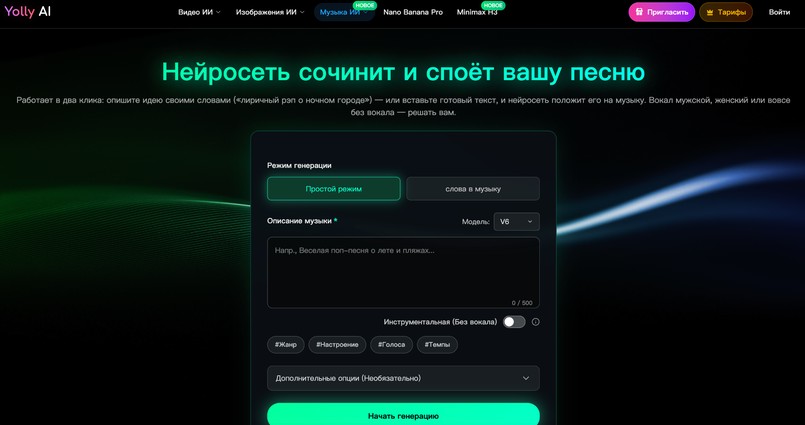
This is an important part of the evolution of AI music. The technology becomes much more useful when creators can express musical ideas in the language they naturally think and write in.
How to Write Better AI Music Prompts
Getting good results from an AI music tool often comes down to the quality of the instructions.
A prompt such as "make a nice song" gives the system very little creative direction.
A more detailed description might say:
"Create a warm indie-pop song about meeting an old friend after many years, with acoustic guitar, gentle drums, nostalgic lyrics, female vocals, and an uplifting chorus."
That prompt gives the system several useful pieces of information.
Start With the Genre
Genre establishes the basic musical territory.
Pop, rock, hip-hop, electronic, folk, jazz, cinematic, R&B, and ambient music all have different characteristics.
Describe the Mood
Mood is equally important.
Words such as dreamy, emotional, energetic, mysterious, romantic, hopeful, melancholic, playful, and dramatic can influence the overall character of the result.
Mention Important Instruments
If certain instruments matter, say so.
Piano, acoustic guitar, electric guitar, synthesizer, strings, bass, drums, and orchestral percussion can all change the sound significantly.
Explain the Vocal Direction
If the platform supports vocals, creators can describe the desired vocal approach.
They might request soft female vocals, powerful male vocals, intimate singing, energetic delivery, or another general vocal character.
Think About the Structure
It can also help to describe what kind of song structure is desired.
For example, a creator might request a quiet verse followed by a larger chorus, or a short intro leading into an energetic hook.
The goal is not to write the longest prompt possible.
It is to provide useful creative information.
The First Generation Is Rarely the Final Version
One common mistake is expecting an AI music generator to produce a perfect song immediately.
Creative tools generally work better when the user treats the first result as a draft.
Maybe the chorus is excellent but the verse feels too repetitive.
Maybe the instrumental arrangement is great but the tempo is too slow.
Maybe the vocals fit the mood but the lyrics need editing.
These imperfections provide useful information.
The creator can adjust the prompt, rewrite the lyrics, change the style, or generate another version.
This is similar to brainstorming with another person. The first idea does not have to be perfect. Its purpose is to give you something to react to.
And sometimes reacting to a bad idea is much easier than starting from a completely blank page.
What AI Still Cannot Replace
Despite all the excitement around AI-generated music, human creativity remains important.
AI can generate musical material, but deciding what actually deserves to be kept is still a creative decision.
A songwriter might use AI to explore melodies and then rewrite the final version.
A producer might generate an arrangement and manually rebuild important sections.
A video creator might generate several tracks and edit one to fit the exact timing of a scene.
In these cases, AI is functioning as a creative tool rather than an autonomous artist.
That distinction matters.
The value of AI music is not necessarily that it removes humans from the process. Its value may be that it lets more humans participate in the process.
The Future of AI-Generated Music
The technology is developing quickly, and future AI music systems are likely to provide more control over individual elements of a song.
Creators may gain better control over melodies, instrumentation, vocal performances, song structure, and individual sections.
Multilingual generation is also likely to become increasingly important as more people experiment with AI songwriting around the world.
For musicians, this could mean faster demo creation.
For YouTubers, it could mean more personalized soundtracks.
For game developers, it could mean faster musical prototyping.
For advertisers, it could mean music designed around specific campaigns.
And for ordinary music fans, it could mean that turning an idea into a song becomes as simple as writing a paragraph.
Final Thoughts
AI music generation is changing the distance between an idea and a finished piece of music.
You no longer necessarily need a studio to explore a song concept. You do not need to be a professional producer to experiment with arrangements. And you do not need to know exactly how a melody should work before hearing what your lyrics might sound like.
Text-to-music and lyrics-to-song systems are giving creators a new way to experiment.
The most interesting part is not simply that AI can generate music. It is that the technology allows people with very different levels of musical experience to participate in the creative process.
A professional musician can use it for rapid experimentation. A content creator can use it for custom video soundtracks. A game developer can use it for prototypes. A songwriter can use it to explore unfinished lyrics.
And someone who has never written a song before can simply type an idea and see what happens.
That last possibility may be the most important of all.
The future of AI music may not be about machines replacing musicians. It may be about making the distance between "I have an idea" and "I can hear it" dramatically shorter.