The AI industry has no shortage of impressive demonstrations. A chatbot can write an article in seconds, an image generator can turn a short description into a polished visual, and a video model can transform a simple idea into a moving scene. But using these tools in real projects is a different story.
Creators often find themselves switching between several applications to finish a single campaign. Developers face another challenge: connecting different AI models, managing API credentials, and keeping costs under control. For small SaaS teams, the goal is not to collect the largest number of AI subscriptions. It is to build a workflow that saves time without introducing unnecessary complexity.
This is where multi-model AI platforms become interesting. Rather than treating every model as a separate destination, they aim to make different capabilities easier to access and combine.
Foxwire.ai and Sozdai.ai are two services worth evaluating from this perspective. Their approaches overlap in some areas, but their usefulness depends on whether a user prioritizes API integration, creative experimentation, or a combination of both.
This review examines their publicly described features, practical applications, potential advantages, and limitations. It does not claim independently measured performance results; instead, it focuses on what users should consider before adopting either platform.
1. What Makes a Good AI Platform?
More Models Do Not Automatically Mean Better Results
An AI platform can advertise dozens of models and still be a poor fit for a particular project. A freelance writer needs reliable text generation, a video creator needs visual consistency, and a developer building an AI-powered application may care more about API compatibility than the appearance of a chatbot interface.
The most useful platform is the one that fits the job.
For example, a small marketing team launching a new SaaS product might need an LLM to develop campaign ideas, an image generation model to create graphics, a video generation model to produce promotional clips, and a music model to experiment with background soundtracks.
A developer building the same company's website might need a different combination: a language model for customer support, an AI coding assistant for implementation, and an API that connects the application to the chosen models.
These workflows have different requirements, even though both use generative AI.
A sensible evaluation should therefore consider several factors:
- Ease of use: How quickly can a user complete a meaningful task?
- Model selection: Are the available models appropriate for the intended workload?
- API integration: Can developers incorporate the capabilities into existing software?
- Cost control: Is pricing understandable, and can spending be monitored?
- Output quality: How much editing or correction is needed?
- Reliability: What happens when a request fails or a generation task takes longer than expected?
These criteria provide a better foundation for comparison than a feature list alone.
2. Foxwire.ai Review: Is Unified API Access Worth It?
A More Convenient Way to Connect AI Models
One of the most frustrating aspects of AI development is discovering that every provider has its own integration details. Authentication methods, model names, request parameters, response formats, and rate limits can differ considerably.
Managing one integration is usually manageable. Maintaining several integrations while developing a product can become a substantial engineering task.
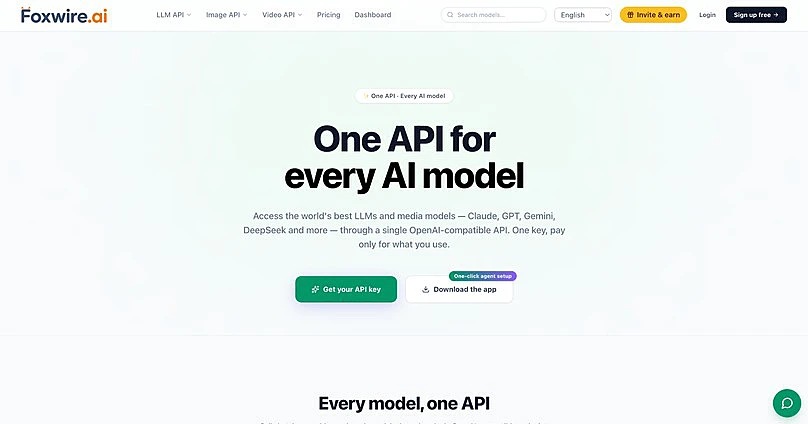
Foxwire.ai takes a unified API approach, with publicly described support for multiple language and media-generation models. For developers, the central appeal is the possibility of accessing supported capabilities through a common entry point instead of creating a completely separate integration for every model provider.
For teams already familiar with OpenAI-compatible APIs, this approach may reduce the work involved in testing alternative models. Depending on the model and features being used, existing SDK-based code may require only a limited set of changes, such as updating the endpoint, credentials, or model identifier.
The precise level of compatibility still needs to be verified. A shared interface does not guarantee that every model supports the same parameters, tool-calling behavior, or multimodal features.
How It Could Help a Small SaaS Team
Imagine a startup developing a content marketing application. Users submit a product description, and the application produces campaign copy, visual concepts, and short promotional media.
The backend could use a language model to draft the copy, an image model to create graphics, and a supported video model to generate short clips. A developer could then connect the results to an editing interface where users review and refine the output.
A unified API layer can make this architecture easier to experiment with, particularly when the team wants to compare different models before settling on a production configuration.
In this context,foxwire.ai is worth evaluating for its multi-model API approach, support for language and media-generation workflows, and usage-based billing model, which may suit developers who want to experiment with different capabilities without immediately managing a separate integration for every provider.
Pricing and Flexibility: What Should You Check?
Usage-based billing can be attractive when workloads fluctuate. A prototype may generate only a handful of images during one week and several hundred during the next. Paying according to consumption can make this type of experimentation easier to manage.
However, usage-based pricing does not automatically mean lower costs. Different language models can have different token rates, while image and video generation may be priced according to different units or processing requirements.
Before choosing a configuration, developers should estimate the cost of a typical task and calculate how that cost changes at higher volumes. They should also account for retries, failed requests, and unnecessary model calls.
A practical test might involve sending the same representative prompt to two supported models, comparing the outputs, and recording both the cost and the amount of human editing required.
The cheapest response is not necessarily the best value if it requires several rounds of correction.
Advantages and Limitations
Foxwire.ai's publicly described capabilities make it a candidate for teams that value flexibility and want a more centralized approach to model access.
Potential advantages include:
- A common API entry point for supported models.
- The ability to experiment with different model families.
- Access to supported text and media-generation workflows.
- Usage-based billing for consumption-oriented projects.
- A possible reduction in the maintenance burden associated with multiple integrations.
There are also limitations to consider. Developers should verify the current model catalog, supported features, rate limits, documentation quality, and pricing before building a production dependency. They should also review privacy and data-handling terms when working with sensitive information.
Review verdict: Foxwire.ai is most relevant to developers and SaaS teams whose main priority is accessing and testing multiple AI models through a more unified API workflow. Its actual value will depend on compatibility, reliability, model quality, and total operating costs.
3. Sozdai.ai Review: A Creative Workspace for AI Experiments
From a Simple Idea to Digital Content
Not every user wants to begin with an API request. Many creators simply want to describe an idea and see what AI can produce.
A content creator might need a visual for a blog post. A musician might want to explore a new soundtrack direction. An independent founder might need a short video to explain a product before investing in a full production.
For creators looking to turn ideas into finished digital content, sozdai.ai offers conversational AI alongside image, video, and music generation capabilities, with developer API options for integrating supported creative workflows into applications.
This combination gives users two potential ways to approach the same project. They can explore ideas through an interactive experience, then investigate API integration when they want to make a workflow repeatable.
For example, a founder could use conversational AI to refine a campaign concept, generate a few visual directions, and experiment with a short video. Once the team identifies a useful workflow, developers can evaluate whether the relevant generation capabilities can be integrated into their own application.
The benefit is a more direct path from experimentation to implementation, although the amount of automation available will depend on the specific features and models involved.
Image Generation: Useful for Rapid Visual Exploration
AI image generation can be particularly useful during the early stages of design.
Instead of commissioning a finished visual before the concept has been approved, a marketing team can generate several rough directions and compare them. A product designer might explore different visual styles, while a blogger could create supporting illustrations for an article.
The quality of the output depends on the model, prompt, reference materials, and requested composition. Users should expect to refine their instructions and review the results rather than assuming that the first generation will be ready for publication.
Consistency is another consideration. If a campaign uses the same character or product across multiple images, reference-image support and other consistency controls may become important.
Video and Music Generation: Extending the Creative Workflow
Video generation introduces additional possibilities for creators who need short promotional clips, concept footage, or storyboards. Music generation can help them explore different soundtracks without immediately commissioning a finished composition.
A small team could use these capabilities to create an early campaign prototype containing copy, visuals, video, and background music. The prototype would then be reviewed and edited before being published.
This approach can reduce the time needed to explore different ideas. However, generated videos may contain inconsistent details, and musical results may need editing to match the intended pacing. Commercial users should also review the applicable licensing terms and usage restrictions before publishing generated assets.

Developer API: Moving Beyond Manual Creation
An interactive creative interface is useful for experimentation, but a developer API serves a different purpose. It allows supported generation tasks to be initiated from software rather than requiring every action to be performed manually.
Sozdai.ai's documented API capabilities are worth investigating for applications that need to generate and retrieve media programmatically. In an asynchronous workflow, an application may submit a task, receive a task identifier, check its status, and retrieve the result after processing finishes.
This pattern can be useful when a video or other media-generation request takes longer than an ordinary text response.
Consider a SaaS platform that allows customers to generate promotional content. The application could accept a prompt, submit a supported generation request, display the processing status, and present the resulting asset when it becomes available.
Developers would still need to handle timeouts, unsuccessful tasks, retries, file storage, and user-facing errors. They should also confirm which models and parameters are available through the API rather than assuming that every feature in a user interface is accessible programmatically.
Review verdict: Sozdai.ai is worth exploring for users who want to experiment with conversational AI and creative generation, as well as developers investigating ways to incorporate supported media-generation capabilities into their products.
4. Foxwire.ai vs. Sozdai.ai: A Practical Comparison
The two platforms can be evaluated using the same broad criteria, but their suitability depends on the workflow being built.This comparison summarizes publicly described capabilities rather than independently verified performance. Available models, prices, and features may change, so developers should consult the latest documentation before making a decision.
| Evaluation area | Foxwire.ai | Sozdai.ai |
|---|---|---|
| Multi-model access | Unified API approach | Multiple AI capabilities and API access |
| Language generation | Supported language-model workflows | Conversational AI and supported language-model workflows |
| Image generation | Supported media-generation workflows | Image-generation capabilities |
| Video generation | Supported media-generation workflows | Video-generation capabilities |
| Music generation | Supported media-generation workflows | Music-generation capabilities |
| Developer integration | Relevant for centralized model access | Relevant for integrating creative generation |
| Cost evaluation | Review usage-based billing and model-specific rates | Review current API pricing and generation costs |
| Best evaluation focus | API compatibility and model-switching flexibility | Creative workflow and supported API functionality |
Which Platform Should Developers Test First?
Developers working on an existing application should begin with API compatibility. They need to know whether the service supports the required models, request formats, authentication methods, and response behavior.
They should also test how easily they can change models and how much application code must be modified when doing so.
For a backend that relies heavily on language models, these considerations may matter more than the availability of a creative interface. For an application built around media generation, asynchronous task handling and output retrieval may be equally important.
Which Platform Should Creators Test First?
Creators should start with the actual output. Can the tool produce images that fit the brand? Can its video capabilities generate useful scenes? Does the conversational workflow help refine ideas, or does it introduce extra steps?
A short pilot project is often enough to identify obvious strengths and weaknesses. It is better to test one real campaign than to generate dozens of unrelated examples that never make it into production.
5. Where Claude Code and AI Developer Tools Fit In
AI model access is only one part of building an AI-powered product. Someone still needs to create the application, connect the APIs, design the user interface, and test the final system.
AI coding tools can help with these tasks. Claude Code, for example, supports coding workflows in which developers can work with project files, investigate errors, and make code changes with AI assistance.
For a solo founder, a coding assistant may help turn a rough product idea into an initial prototype. For an established development team, it may speed up routine tasks such as writing tests, explaining unfamiliar code, or drafting implementation changes.
Multi-model APIs and AI coding assistants solve related but different problems. The coding assistant helps with software development, while the API provides access to the models that an application uses.
A developer could use a coding assistant to build a content-generation dashboard and connect it to a media-generation API. The resulting application might allow customers to create marketing text, request images, and submit video-generation tasks through one interface.
However, compatibility must be checked carefully. An API that supports standard SDK requests is not automatically compatible with every coding assistant, agent framework, or authentication flow.
Generated code also requires human review. Developers should inspect changes, run tests, protect credentials, and avoid giving AI tools unnecessary access to production environments.
6. A Simple Test Plan Before Choosing a Platform
Product descriptions are useful for discovering features, but they cannot replace testing. Before committing to a service, run a small evaluation based on the tasks you expect to perform.
Test 1: Compare Real Outputs
Choose a few representative prompts for writing, image generation, or video creation. Assess quality, consistency, and the amount of editing required to produce an acceptable result.
Test 2: Measure Integration Effort
For API-based projects, build a minimal working example. Check authentication, request submission, response handling, and the process of retrieving generated media.
Record the engineering time involved. A service that looks inexpensive may become less attractive if its integration requires extensive custom development.
Test 3: Estimate the Total Cost
Calculate the cost of a typical project rather than focusing on the price of one request. Include retries, failed generations, additional model calls, and any relevant infrastructure costs.
For high-volume applications, run estimates at several usage levels so that you understand how costs may change as the product grows.
Test 4: Check Reliability
Test what happens when a request fails, a generation task takes longer than expected, or a model is temporarily unavailable. Production applications need clear error handling and sensible retry policies.
Test 5: Review Privacy and Usage Rights
Before using a platform with customer data or confidential materials, review its data-handling policies and security controls. For generated content, confirm the licensing terms and commercial-use restrictions that apply to the selected service and model.
These checks help turn a general product comparison into a decision based on your own requirements.
Final Verdict: The Best AI Tool Is the One That Fits Your Workflow
Foxwire.ai and Sozdai.ai address different parts of the growing demand for accessible generative AI. Foxwire.ai is worth evaluating when unified API access, model flexibility, and usage-based consumption are central to a developer's requirements. Sozdai.ai is worth exploring when conversational interaction, creative generation, and API-driven media workflows are important.
Neither should be considered the universal winner without comparable tests of output quality, cost, reliability, and integration effort. The right choice depends on what you are building and how you intend to use the service.
For creators, the best starting point is a small project that combines text and media generation. For developers, it may be a prototype that tests a language-model endpoint and a media-generation workflow. For SaaS teams, it may be a controlled comparison of API integration effort and operating costs.
The broader lesson is that successful AI adoption is not about using the newest model for every task. It is about choosing suitable capabilities, connecting them sensibly, and reviewing the results before they reach customers.
When an AI platform makes that process easier without introducing unnecessary complexity, it becomes more than another tool in a crowded market. It becomes a practical part of the workflow.