If you're a recruitment agency evaluating Applicant Tracking System (ATS) tools, you've probably come across both Jarvi and Greenhouse. They both sound capable on paper, and depending on which demo you watched last, you might have walked away impressed by either one.
But an ATS is not just a place to store candidate data anymore. It is the system your team lives in every single day, shaping how fast you move, how well you manage client relationships, and how much time your recruiters spend on actual recruiting versus admin work.
Jarvi and Greenhouse are both solid platforms, but they are built for different buyers, and picking the wrong one costs you time, money, and momentum.
This article breaks down exactly how the two compare so you can make a clear, confident decision.
TL;DR: Jarvi vs Greenhouse at a Glance
What to Look for in an Applicant Tracking System (ATS)
Picking an ATS comes down to how well it fits your actual hiring workflow. Here is what matters most, regardless of your team size or structure.
- Combined ATS and CRM. Candidate tracking and relationship management working together in one place means cleaner data, better visibility, and fewer things falling through the cracks.
- Automation that handles repetitive work. Stage transitions, follow-ups, and data entry should run on their own so your team can focus on the conversations that actually move the needle.
- Multi-channel outreach. Candidates are reachable across LinkedIn, email, messaging apps, and phone. A platform that centralizes those channels saves a lot of context-switching throughout the day.
- Transparent pricing. The plan you start on should give you a clear picture of what you are paying as you grow. Surprises in the bill tend to come from features that are tiered or scoped in ways that are not obvious upfront.
- Smooth onboarding and data migration. Getting set up should not be a project in itself. Look for a platform that helps you move your existing data over cleanly and gets your team productive quickly.
What is Jarvi?
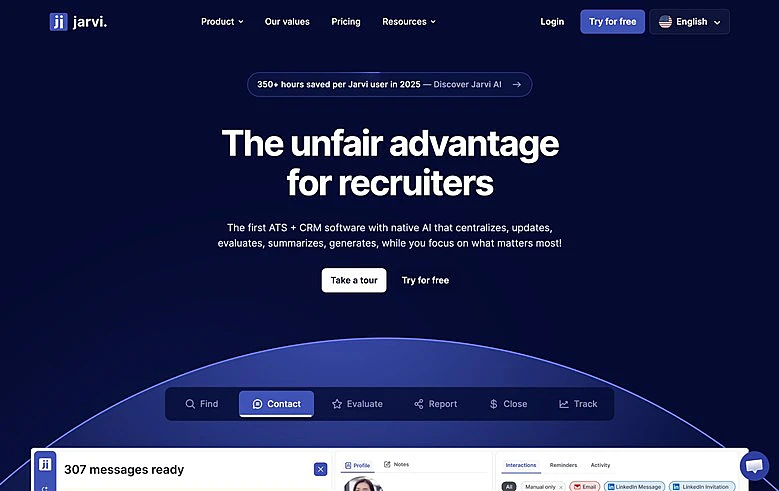
Jarvi is an AI-native recruitment platform built specifically for staffing agencies, executive search firms, and freelance recruiters. It combines an ATS, CRM, and multi-channel outreach into a single system, so your entire operation lives in one place.
There is no separate tool for candidate management, another for client relationships, and a third for outreach. Jarvi replaces all of that. The AI runs across every workflow by default, handling data capture, candidate scoring, message generation, and reporting without extra configuration.
Key Features
- ATS and CRM in one system: Manage candidates and client pipelines side by side, with full interaction history across both, from a single login
- Multi-channel unified inbox: LinkedIn, email, WhatsApp, Telegram, SMS, and calls, all in one place, with automated follow-ups and personalized campaigns
- AI agent across all workflows: Automated data capture, candidate scoring, resume generation, outreach drafting, and reporting built directly into the platform
- Visual Kanban pipeline: Track candidates and deals across stages with real-time updates, workflow automation, and one-click status changes
Pros
- Replaces ATS, CRM, note-taker, outreach tool, AI assistant, and resume generator with a single platform
- Every feature is included in a single plan, no tier upgrades needed
- Free hands-on migration and onboarding included
Cons
- Newer platform with a smaller public review base
- Best suited for agencies
Pricing
Jarvi runs on a single all-inclusive plan at $158 per user per month, billed annually at $1,899 per year. Monthly billing is also available. Volume discounts apply for teams of 10 or more users, and annual billing saves you 13%.
The plan is all-inclusive, with ATS, CRM, multi-channel outreach, an AI agent, a resume builder, a note-taker, and reporting.
A free trial is available with full feature access and no credit card required.
What is Greenhouse?
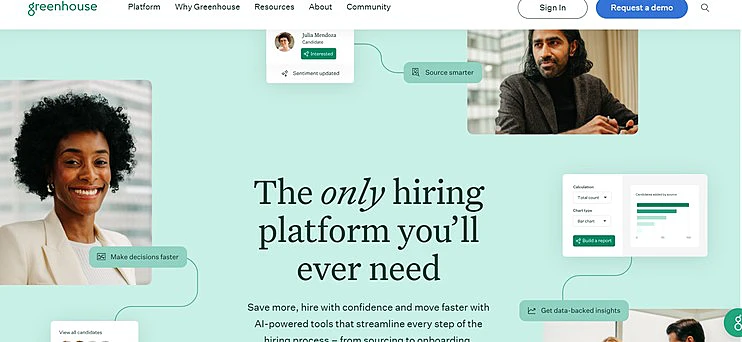
Greenhouse is an enterprise-grade hiring platform built for internal talent acquisition teams at scaling companies and large organizations. It handles the full hiring lifecycle from sourcing through onboarding, with tools for structured interviewing, DEI tracking, compliance, and standardized evaluation.
The platform solves a real problem for in-house teams that need to run high-volume, structured hiring across departments.
Key Features
- Structured hiring workflows: Standardized interview kits, scorecards, and evaluation frameworks for consistent, bias-reduced decision making across hiring teams
- AI-assisted recruiting: Talent rediscovery, resume parsing with anonymization, interview transcription, automated report generation, and offer timeline forecasting
- DEI and compliance tools: Diversity tracking, anonymized assessments, and audit-ready reporting for organizations with governance requirements
- Broad integration ecosystem: 400+ pre-built integrations and open API access for connecting HRIS platforms, background check tools, and analytics systems
Pros
- Structured hiring and interview frameworks
- DEI tracking and compliance reporting built-in
- Offers forecasting and advanced reporting
Cons
- No client management, sales pipeline, or deal tracking
- Advanced integrations and features are locked to higher-priced tiers
- WhatsApp, Telegram, and calling require third-party tools
Pricing
Greenhouse uses custom pricing across three tiers (Core, Plus, and Pro), ranging from approximately $14,000 to $59,000 per year, based on G2 data.
Bulk candidate import is only available on Plus and Pro plans. You can request a demo to receive a quote.
Jarvi vs Greenhouse: Feature-by-Feature Breakdown
1. Candidate and Pipeline Management
Jarvi gives you a visual Kanban pipeline where candidates move across stages with full interaction history, AI-assisted scoring, and workflow automation. Stage transitions, follow-ups, and status updates happen automatically. Every message, meeting, and activity is logged in real time. The pipeline also connects directly to your client and deal tracking, so you are managing the full picture in one view.
Greenhouse structures hiring through standardized interview kits, scorecards, and predefined criteria. It is genuinely well-built for in-house teams coordinating across multiple hiring managers and departments. Its pipeline is strong for internal hiring.
Choose Jarvi if you are managing placements across multiple clients and need your candidate and client data connected. Greenhouse is a fit if you are an internal team that needs structured, standardized evaluation across a large hiring organization.
2. Multi-Channel Outreach and Communication
Jarvi brings LinkedIn, email, WhatsApp, Telegram, SMS, and calls into a single unified inbox. Outreach campaigns, personalized messaging, and automated follow-ups all run from the same place, and every interaction is tracked automatically. You manage conversations across channels without switching tools.
Greenhouse supports email and text natively, with LinkedIn integration available through LinkedIn Recruiter System Connect, including InMail and profile syncing. WhatsApp and Telegram are not natively supported and require third-party integrations. There is no native calling.
Jarvi is better-suited if your recruiters work across LinkedIn, WhatsApp, and email simultaneously. Greenhouse can be a choice if your outreach is primarily email-based and LinkedIn.
3. CRM and Client Management
Jarvi includes a full agency-facing CRM. You can manage client profiles, track deals across stages, run prospecting campaigns, and see a complete history of every client interaction. Sales pipeline management runs alongside your recruitment pipeline in the same system.
Greenhouse has CRM functionality, but it is designed for internal hiring teams managing candidate relationships and talent pools. The agency partner feature allows external recruiters to submit candidates to a Greenhouse system, but that is a submission portal, not a client-facing CRM.
For agencies managing client relationships, Jarvi is the more natural fit.
4. AI Capabilities
Jarvi's AI is embedded across the entire platform from the ground up. It automatically captures data from calls and messages, scores candidates, drafts outreach, generates resumes and summaries, and updates records continuously. It operates with the complete context of your pipeline and communication history without extra setup.
Greenhouse uses AI across several specific features, including resume parsing with anonymization, talent rediscovery, interview planning, transcription, and forecasting. AI-powered report filters are available on higher-tier plans.
Both platforms offer genuine AI functionality. Jarvi suits agencies that want AI running across their full workflow from day one. Greenhouse suits in-house teams that want AI to support structured hiring decisions and reporting.
5. Pricing
Jarvi charges $158 per user per month with everything included. No tiers, add-on fees, implementation cost, or migration fees. You know exactly what you are paying before you sign anything.
Greenhouse pricing starts at approximately $14,000 per year and reaches $59,000 per year, depending on the plan, all on custom quotes. For a growing recruitment agency, this is a meaningful difference, both in budget and in predictability.
Jarvi is the clearer choice on pricing for agencies of any size. Greenhouse's cost structure makes more sense for enterprise organizations with large internal HR budgets.
When to Choose Jarvi
Choose Jarvi if:
- You run a recruitment agency, staffing firm, or executive search practice and want ATS, CRM, outreach, and AI in one platform
- You manage both candidates and clients actively and work across LinkedIn and WhatsApp
- You want transparent pricing and hands-on onboarding support included from day one
When to Choose Greenhouse
Choose Greenhouse if:
- You are building an internal talent acquisition function inside a scaling company or enterprise
- You need structured hiring with evaluation frameworks, DEI tracking, compliance reporting, and onboarding workflows
- You coordinate hiring across departments with no need for client management or multi-channel prospecting