AI transforms music production, democratizing creation. These tools efficiently generate high-quality tracks and videos. This review examines platforms offering robust automation: their features, tradeoffs, and pipelines, focusing on streamlining processes and quality management.
1. MakeSong — The Cinematic AI Music Video Producer
 TOP AI MUSIC TOOLS
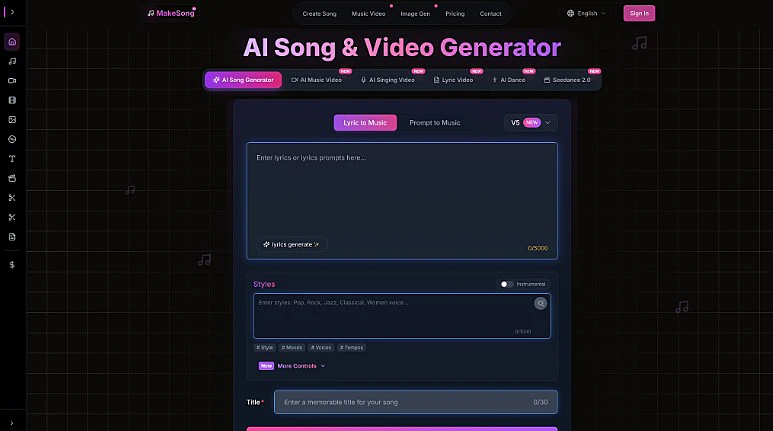
MakeSong automates complex music video creation, focusing on lip-sync and visual synchronization, efficiently transforming audio into compelling visual narratives.
Automation Capabilities
MakeSong automates video production, leveraging advanced Lip Sync AI Free for precise avatar mouth alignment. It dynamically automates camera movements, transitions, and effects based on audio rhythm and mood. Users define high-level parameters; AI generates cohesive visual narratives, transforming static audio into engaging multimedia.
Automation Tradeoffs
MakeSong's automation trades granular control for efficiency. Auto-generated visuals may lack unique flair or narrative nuance, leading to predictability. QA checks for uncanny valley effects or repetitive patterns; bespoke looks often require iteration. Clean input audio is crucial, as imperfections amplify visually.
Production Pipeline
MakeSong's pipeline prioritizes efficiency. Users upload audio, select an avatar, and provide style directives. AI automatically generates lip-sync animation and the full music video with camera angles and effects. Creators preview, make minor adjustments, then render and download, significantly reducing traditional production time.
2. AIsong — Your Personal AI Songwriting Assistant
.jpg?x-image-process=image%2Fauto-orient%2C1%2Fresize%2Cm_lfit%2Cw_1920%2Fsharpen%2C100%2Fformat%2Cwebp%2Fmarker%2Cu_plus "Top AI Music Tools for Automated Song Production") Top AI Music Tools for Automated Song Production
Top AI Music Tools for Automated Song Production
AIsong is an AI Song Generator specializing in generative music, crafting melodies, harmonies, and instrumental arrangements from text prompts for quick musical ideas.
Automation Capabilities
AIsong extensively automates music composition. Users input natural language (genre, mood, tempo, instrumentation); AI generates unique musical sequences: melody, harmonic progression, rhythm. It translates lyrical ideas into structured pieces (intro, verse, chorus, outro). The platform orchestrates by selecting virtual instruments, reducing manual composition for non-musicians to rapidly produce sophisticated music.
Automation Tradeoffs
AIsong's automation can result in formulaic music, lacking emotional depth or nuanced artistic expression. QA involves listening for repetitive patterns, predictable progressions, or sterile dynamic variation. Customization is challenging beyond trained parameters. Users may need to refine prompts or make minor manual edits to introduce human elements, better for rapid prototyping than groundbreaking music without iterative intervention.
Production Pipeline
AIsong's production pipeline is intuitive and text-driven. Users provide descriptive prompts (e.g., "upbeat folk song") to guide AI, which automatically generates a complete musical track. Users preview, evaluating adherence/quality. For adjustments, they modify prompts/tweak parameters (tempo, key, instrumentation), allowing section regeneration. Once satisfied, the track downloads in various audio formats.
3. Boomy — Instant AI-Generated Original Tracks
 Top AI Music Tools for Automated Song Production
Boomy offers instant original, royalty-free music, prioritizing speed and ease for creators, game developers, or anyone needing background music without traditional complexities.
Automation Capabilities
Boomy automatically composes/produces original songs. Select a style (e.g., "Relaxing Electronic"); AI instantly generates a unique track: melody, rhythm, harmony, instruments. It handles full arrangement/mixing for a professional sound. Users customize tempo/key via sliders, triggering adjustments. Boomy automates track organization and facilitates releasing AI music to streaming platforms. Teams can also tune prompt constraints to keep style consistent across multiple deliverables in one release cycle.
Automation Tradeoffs
Boomy’s automation sacrifices deep creative control. While genre/mood are influenced, melodic/harmonic nuances are AI-dictated, resulting in proficient but generic tracks. QA often reveals repetitive outputs. Customization is limited to broad adjustments, not precise editing. Users with specific ideas may find Boomy's automated approach limiting, requiring compromises. Editorial review remains necessary because automated drafts can miss brand nuance and audience-specific emotional pacing.
Production Pipeline
Boomy's pipeline is straightforward for rapid output. Users choose genre/mood; one click generates a unique track. Minimal refinement allows adjusting tempo/energy with sliders, triggering recomposition. Users can regenerate. Once satisfactory, tracks are saved, downloaded, or uniquely, submitted for distribution to major streaming services directly. A weekly review loop with saved prompts and revision notes improves reliability for recurring publishing schedules.
4. Ecrett Music — Royalty-Free AI Music for Creators
 Top AI Music Tools for Automated Song Production
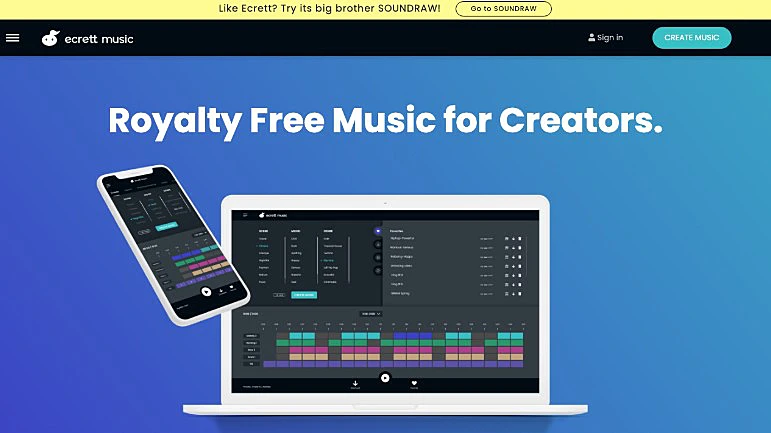
Ecrett Music provides royalty-free background music for video creators, podcasters, and presentations. Its strength lies in efficiently generating context-appropriate music that fits a scene or mood without complex musical knowledge.
Automation Capabilities
Ecrett Music automates mood-specific, scene-fitting background music. Users select "Mood," "Scene," "Genre"; AI instantly generates a unique, royalty-free track. Automation structures music with intros, loops, and emotional tones, handling instrumentation, tempo, and harmonic progressions. Automated length adjustment allows specifying duration, adapting the track precisely without awkward cuts—valuable for video editors. Teams can also tune prompt constraints to keep style consistent across multiple deliverables in one release cycle.
Automation Tradeoffs
Ecrett Music’s automation specializes in functional background music, less suited for complex/experimental compositions. QA often reveals music lacks distinctiveness or strong melodic identity, blending as intended. This limits creators seeking memorable scores. Customization is limited; users refine mood/scene, but granular control over individual notes is unavailable. Output is "as is" with minimal deep editing. Editorial review remains necessary because automated drafts can miss brand nuance and audience-specific emotional pacing.
Production Pipeline
The Ecrett Music pipeline focuses on quick, functional music generation. Users select "Mood," "Scene," "Genre." AI automatically generates a unique music track. Users preview and fine-tune parameters. A crucial automated feature specifies exact desired track length, which AI adjusts accordingly. Once satisfied, the royalty-free track downloads for immediate project integration. A weekly review loop with saved prompts and revision notes improves reliability for recurring publishing schedules.
5. Suno — Generative AI for Vocal and Instrumental Tracks
 Top AI Music Tools for Automated Song Production
Suno is a powerful generative AI tool creating full songs, instrumental and vocal tracks, from text prompts. It pushes AI music generation boundaries by incorporating human-like singing and lyrics.
Automation Capabilities
Suno offers advanced automation in comprehensive song creation: lyrics, melody, harmony, instrumentation, realistic vocals. Users provide text prompt/lyrics; Suno's AI compiles unique song structure, generates instrumental backing, and creates natural-sounding sung vocals. It can even generate original lyrics. Holistic automation means users go from concept to a fully produced song with a lead singer in moments. AI handles intricate interplay between vocals/instrumentation. Teams can also tune prompt constraints to keep style consistent across multiple deliverables in one release cycle.
Automation Tradeoffs
While Suno’s vocal generation is groundbreaking, its high automation presents significant QA challenges. Generated lyrics/vocals can feel disjointed, nonsensical, or emotionally flat, lacking human depth. Voices occasionally veer into the uncanny valley. Users may regenerate tracks for acceptable performance. Creative control over vocal inflections/arrangements is limited, requiring iteration or accepting AI's interpretation. Editorial review remains necessary because automated drafts can miss brand nuance and audience-specific emotional pacing.
Production Pipeline
The Suno production pipeline is text-to-music generation. Users type a text prompt describing the desired song—specifying genre, mood, instrumentation, optionally lyrics. AI processes this, generating a song segment (1-2 minutes) with instrumental backing/sung vocals. Users listen, then extend or regenerate segments. Deep manual editing is not the primary interaction. Completed songs can be downloaded.