The last few years have seen a phenomenal change in the way we work and transact online. Automation tools are everywhere, and with AI, the pace of doing things has improved dramatically.
As Sundar Pichai, the CEO of Google once said, AI and automation are in some ways more profound than the discovery of electricity and fire.
In this context, it is fair to say that online shopping too has seen a paradigm shift in how it operates - both for the seller and the buyer. As any long-term industry observer will tell you, each step of this journey has evolved significantly over the past few years.
This article is a chronicle of the different ways AI and automation is changing online shopping. Let’s get started.
The anatomy of online shopping
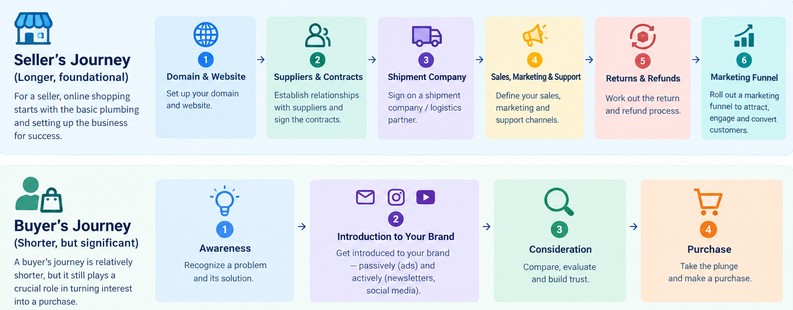
The online shopping journey starts much before the customer hits ‘checkout’ on your eCommerce website.
For a seller, online shopping starts with the basic plumbing - setting the domain and website up, establishing relationships with suppliers and signing the contracts, signing on a shipment company, defining the sales, marketing, and support channels, working out the return and refund process, and rolling out a marketing funnel.
A buyer’s journey is relatively shorter but equally significant. It starts with being aware of a problem and its solution, being passively introduced to your brand actively (through newsletters and social media accounts) and passively (through ads), and finally taking the plunge towards a purchase.
Not every buyer’s journey is the same. Some customers discover a need, search for it online to find your ad. They click into your website and make a purchase without being added to your funnel. Yet, as a seller, it is important to anticipate the different kinds of buyer journeys that exist and prepare a roadmap for each one of them.
How AI and automation create impactful changes to the journey
One of the big pain points that startup eCommerce store owners face is the inability to make data-driven decisions. Picking a supplier or a shipment company is based on prices and customer reviews. But are they the best fit for someone based in your city? Or, are they the best suppliers for the specific kind of fabric you want to use for your product?
This inability to make data-driven decisions can haunt you along each step of the journey. For example, what marketing channels do you invest in? Is advertising on TikTok better than Google?
With AI, it is now possible to transcend large datasets of public as well as private information to identify the best path forward in each step. In some cases, you could start without defining the first step and let AI figure it out.
An AI-first creative agency, establishing an AI-first approach into your process isn’t just about the speed of execution. It also helps save time without compromising quality, and helps automate repetitive tasks without losing creativity.
This is also true with automation. Startup eCommerce businesses are bootstrapped and often one-person teams. These teams face a catch-22 situation with respect to scaling up. This is because you need to hire in order to scale up, but again, you cannot afford these overheads till your business has grown.
Automation helps overcome this growth barrier. Modern automation tools can help businesses replace human resources with software tools for a fraction of the price. This helps you scale faster and more productively while allowing you to secure the resources required to invest in further growth.
Automation in the seller journey
The seller journey starts with product research and sourcing, and goes through a series of increasingly complex steps - including platform selection, product listing and optimization, marketing and launch, fulfillment and shipping, and finally operations and support.
Here is a look at how AI and automation can assist with each step of this process.
Product research and sourcing
In the early stages of launching an online shop, finding the right product and market can be extremely critical. One wrong step at this stage of the journey could be an expensive mistake to fix later.
Product research and sourcing includes finding the most profitable items to sell, testing the samples, deciding on a business model (private label, wholesale, or dropshipping), and also settling on the right distribution channels (own store, Etsy, eBay, Amazon, etc.).
Modern AI tools can help with trend spotting and the supplier vetting process. These tools scan social media, search engines, marketplaces, as well as proprietary platforms like Google Trends to predict high-demand products before they go viral.
These tools can also help identify the longevity of these trends. This is important if you are going for a long-term business that does not rely on fads and pop trends.
Once you have picked the right products, automation tools can replace hours of manual labor by automatically scraping a list of vetted suppliers from reliable third-party platforms and build a comparison table benchmarking their respective manufacturing costs, defect rates, and shipping times.
Alternatively, if you choose to dropship, then some platforms can help you design custom products and print them on demand. With API, in fact, it makes it possible to automate the whole process and produce these goods at scale.
The power of AI and automation does not stop here. You can also make use of AI agents to go one step ahead and reach out to all these different suppliers and negotiate prices without manual intervention.
Platform selection and channel mix
One of the key challenges with running an online shop is identifying the right mix of distribution channels to go after. Most D2C eCommerce brands opt for a mix of a native eCommerce setup (on platforms like Shopify or a Shopify alternative, such as Shopaccino) and third-party marketplaces like Amazon.
Picking the right mix can be crucial since your logistics planning is dependent on this. Stocking too much in the Amazon warehouse could mean stockouts on your eCommerce website. While there are definitely workarounds to this (like using Amazon MCF for your fulfillment), these options come at a cost.
If you want to build an AI-native business, it is also important to pick a platform that can run seamlessly with AI agents. For example, you could use a no-code integration platform like Albato to connect your eCommerce platform with multiple AI agents. For example, with Albato, you can connect your Shopify with WhatsApp Business and OpenAI so that a customer seeking order status on WhatsApp can directly get the response in natural conversational text instantly.
AI-powered demand management tools can help with identifying the right product catalog using traffic patterns, and technical requirements. Machine learning programs can also help with simulating operational loads, and identifying the right integrations. Some tools like Triple Whale can help understand shopper behavior, solve attribution, and measure your impact across different distribution channels.
Product listing and optimization
Most modern eCommerce platforms come equipped with native tools that can help you upload your product catalog in bulk, and this honestly saves a lot of time. But that is just one part of the listing and optimization process.
AI-powered Product Information Management systems like Hypotenuse take it one step further by offering automatic enrichment of product attributes, standardizing and validating product data at scale, auto-tagging and categorizing of products, and generating product descriptions in bulk - with little manual intervention.
For effective eCommerce management, it is important to continually benchmark your product catalog, pricing, and description against competing products in the same marketplace as well as across the internet.
This helps your products stay eternally competitive and optimized for the highest conversion.
Visuals play a big part in eCommerce product listing management. For stores with thousands of products in the catalog, optimizing each product image before upload used to be the job of a full time graphic artist.
With AI however, this process has become extremely scalable. For example, you could use the AI Image Editor on Envato to easily remove backgrounds, erase objects, and upscale your product images effortlessly before upload.
An AI agent platform can help you build customized AI agents to help you with revenue analysis, campaign performance analysis, vendor contract review, demand forecasting, catalog management, and several other aspects of your eCommerce business.
Marketing and launch
Marketing your eCommerce can be tricky business and this is exactly where AI and automation can be so handy. There are an incredible number of tools that can help you out along every step of the way.
Tools like Emitrr can help set up automated marketing sequences to nurture and convert customers.
Choosing the right email marketing platforms can also help ecommerce businesses automate campaigns, segment audiences, and deliver personalized messages at scale
You can also bring real-time customer data to your email, SMS, paid-media and on-site marketing assets to deliver personalized product recommendations and retention levers to each customer.
If you run your store on a platform like Shopify, you could further integrate it with an app like Kanal to deploy a WhatsApp communication channel with your customers. According to Nicolas Provost, co-founder of Kanal, "shoppers already use WhatsApp every day to talk to friends and family". Automating this conversation can ensure that the "the message goes out at the right moment."
With a 96% open rate, WhatsApp is an ideal platform to send order and shipping updates, as well as help recover abandoned carts.
Social media is another big part of eCommerce marketing. AI tools can help businesses generate cinematic quality product videos and visuals that can be produced at scale and distributed across various channels like Instagram, Tik Tok, and YouTube.
AI Solutions can help drive highly personalized customer success campaigns that are AI-driven and highly personalized. Such tools can help eCommerce businesses identify your best customers based on their satisfaction scores, engage with them, analyze and optimize your campaign performances, and get full visibility on your customer success operations.
Fulfillment and shipping
Identifying the right shipping agent for an order, coordinating the timelines with the customer, and also constantly optimizing shipping operations to improve customer satisfaction is a major KPI for every eCommerce store. Inconsistent delivery timelines can ruin customer experience and could be fatal to your eCommerce growth.
Shipping automation tools can drive highly optimized delivery schedules by using AI to automatically assign the right carriers to an order, auto-fix address and labeling errors, and handling customized special orders at scale.
Such automation tools can bring down your costs while also improving delivery efficiency.
Operations and support
Running an eCommerce operation is never smooth sailing as each order is unique and can come with its own set of problems. Setting up policies that are scalable while being able to address customer concerns at an individual level can be a complex process.
With the AI and automation tools at our disposal today, a lot of these complexities can be navigated quite seamlessly.
Jivochat’s AI agents can assist with resolving up to 80% of customer conversations automatically without the need for manual intervention. This helps expand support bandwidth to focus on the more unique cases.
This process is further enhanced with the Jivochat AI assistant that uses OpenAI technology to help support teams write faster and more diversely.
If you are looking to automate conversation across other social media channels like Instagram or WhatsApp, you could explore a tool like Heyy for chat automation.
Automation in the buyer journey
The eCommerce buyer’s journey is relatively shorter compared to the seller’s. It starts with product and brand awareness, and slowly transitions to research, and conversion. This is followed by post-purchase engagement and advocacy.
AI and automation serve each step of this journey.
Product and brand awareness
This is the first step of the process when a prospective buyer is made aware of a problem or learns about your eCommerce store for the first time.
Today, a lot of awareness is built through hyper-personalized targeting made possible with the help of AI-powered audience targeting and through dynamic SEO optimization where automation tools track search trends in real-time and update product copy and keywords to match intent.
Automated drip campaigns help nurture the audience one-step towards conversion. With AI-powered automation engines, businesses can also send hypertargeted product recommendations based on the recipient’s purchase history.
Affiliates and influencer referrals make up a big chunk of eCommerce marketing. Affiliate marketing tools offer APIs that bridge the gap between influencer/affiliate discovery and the final conversion. The API removes purchase friction and aligns marketing touchpoints with consumer behavior.
Product consideration and research
At the consideration stage of the buyer’s journey, much of the time is spent on finding the right solution to a customer’s problem, comparing alternatives, and seeking social proof.
AI-powered search engines like ChatGPT, Perplexity, and Google’s AI Mode can help study hundreds of different products and reviews to shortlist products based on your unique needs - be it price, shipping time, product features, or customer reviews.
Apps like Honey can help shoppers look for coupon codes automatically when they shop. They can also compare the price of a product across various shopping sites to find one with the best price for you.
Conversion
This is the most epochal moment of the eCommerce journey for both the buyer and the seller. It is the moment when the buyer votes with their wallet and the seller realizes if their strategies have been working or not.
There are a few ways AI and automation serve this stage of the buying journey. Jivochat’s marketing chatbots can launch personalized offers for each buyer at the point of sale in order to convert a potential lost sale into a buying customer.
Post-purchase
We have discussed a fair bit of the tools that help with post-purchase operations from the seller’s side. Much of the same automation tools also offer relevant products to buyers to make their journey more seamless.
Smart order tracking bots can automatically check the status on each order and update customers. NLP-based customer support tools can categorize customer emails based on the content and route urgent issues to human agents based on criticality.
Jivochat is one of the most popular business messenger services in the market today with an impressive G2 rating of 4.6 out of 5.
Advocacy
Once a product has been delivered successfully, the final step of the buyer journey is consumption and customer happiness. From a seller’s standpoint, this is the right moment to garner customer advocacy.
Automated review prompts are triggered based on a customer’s engagement in the post-purchase journey. Social media monitoring study platforms like TikTok and Instagram for customer complaints and addresses them as soon as they are discovered.
Ensuring a smooth eCommerce journey
The integration of AI and automation has evolved from a "nice to have" sophistication to a ‘must have’ baseline for eCommerce operators today. Retailers who adopt these intelligent systems are better suited to eliminate friction in the journey and maximize their customer conversion.
As such tools become cheaper and more accurate, eCommerce businesses are noticing the inevitability of these tools in the modern eCommerce workspace. This is the only way to ensure your business is competitive and offers a long-term value proposition to your customers, and keep them loyal to your brand.